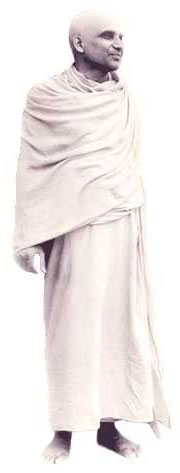
by Swami Krishnananda
The energy that is spent by the senses should be conserved through the stoppage of the activity of the senses. When the senses are prevented from their functions, there is a natural revolt of the senses, as a reaction to the attempt at their subdual. The reason for this revolt is that the energy that is withdrawn from the senses is, usually, not utilised well. No energy can rest in suspension, without being used; it shall find a way out. Hence the totality of sense-energy should be dissolved in the mind, so that there may not be any chance or possibility of its being expressed once again through the senses. But the mind also, being an organ which is an extrovert in nature, may project itself again through the senses, if the energy is allowed to stay in the mind without being utilised for a purpose. Generally, forced stoppage of sense-activity without proper discrimination results in nervousness, excitement, confusion and ultimately a kind of mental aberration. For this reason, the energy of the mind should be spent in the process of purifying it and transforming it into the purity of intelligence. The character of intelligence is not dynamic energy, but unruffled consciousness. Consciousness does not require itself to be spent out, because there is nothing subtler than consciousness. But, when the mental energy is transformed into the intellect, it remains in the individual in the form of a dynamic power. Power is always objective and tends to motion. Power cannot rest in itself and so forces itself out in some way or the other. The intellectual energy should therefore be reduced to universal consciousness or Mahat, where there is no danger of power getting itself externalised. The Mahat should further be reduced to the Santa-Atman or the Absolute Self which is free from even the possibility of objective consciousness. This is the ultimate Goal. The drift of the whole statement is that all ideas, names and forms, actions and their results, have to be resolved into their Source, by a knowledge of its absoluteness.
The Sruti says, "Arise, Awake! Through obtaining men of wisdom, know it. A sharpened edge of a razor, hard to tread, a difficult path it is - thus sages declare." The individuals of the universe are all sleeping persons or dreamers in the night of ignorance. They are exhorted to wake up to the day of knowledge. The path of Sadhana is beset with great dangers. The Sadhaka has to experience sorrows and very unpleasant conditions in the process of the transformation of the individual into the Supreme Reality. Knowledge arises, in the beginning, not through mere self-effort, but through the company of the wise, the result of which is accelerated by the effects of past meritorious deeds. Self-effort takes the form of an intellectual undertaking, and the intellect being very strongly influenced by internal convictions and experiences of the individual concerned, the effort is many times not well directed. Every right effort should be preceded by right thinking, and no right thinking is possible as long as the individual is controlled by personal prejudices and desires. Hence the need for the company of the wise, which shall break open the fort of preconceived notions in the individual. Further, the path is a very difficult one to tread. The search for Truth is attended with many dangers. The Sadhaka is likely to be tempted, opposed, misled or held up on the way. The inner propensities take concrete forms and present themselves before the seeker because of his attempt at concentration of mind. Concentration is a death-blow given to mental desires, and hence the latter rise up with all might to put an end to the practice of concentration. Moreover, Sadhana is the method of the disintegration of the personality consisting of the five material sheaths. These sheaths include within themselves the substance of the entire universe. Therefore, when the aspirant turns his face against these sheaths, he is actually acting against the lower natural current of the whole external universe of manifestation. Here lies the danger of the practice. The objective powers of the universe rebel against the internal consciousness, and though this consciousness is more powerful than any objective power, it does not appear to be so because of its non-manifestation. The aspirant seems to be defeated, because his condition is one where the external tendencies are opposed and the internal Self is not known. Hence, he has no help until a higher state is reached, though he is unconsciously being led higher by the law of the Absolute. It is in this helpless condition of the absence of knowledge that the power of the result of previous discriminative practices raises the individual above the material entanglements. The object of knowledge is too subtle to be easily known, and the object of the senses is too gross to be easily avoided. This is the reason why there is every likelihood of the seeker's falling back into relative experience. But there is one great helping hand which pushes forward every Sadhaka, in spite of the several oppositions before him. Every bit of action that is done as a Sadhana for perfection produces such a power that it can never be destroyed by any material force of the universe. When a Sadhaka is opposed by an external power, the impression of the previous practice urges him forward, and this forward march is another act which adds another fresh stock of power to the already existing one. Every step taken forward adds more power to the previous stock, and the cumulative effect of Sadhana-Sakti becomes so great that it is able to overcome any external power. The subject is always more powerful than the object, because the subject is conscious and influences the object. The knower has a power over the known. The fact that the knower has the power to know the entirety of Nature shows that Nature is subservient to the knower. If the knower were less than the known, it would never have been possible for the knower to have complete knowledge of anything. Knowledge of everything means transcending everything in quality as well as in quantity. The path to perfection is, therefore, the way to the expansion of the localised being into limitless existence. Since every being is essentially consciousness, it is possible for everyone to become the greatest and the best, and exist as the Absolute, in the end.
When that which is soundless, touchless, formless, changeless, tasteless, eternal, odourless, beginningless, endless, greater than the cosmic intellect, the permanent being, is known, one is liberated from the mouth of death.
That which is characterised by qualities like sound has to modify itself, because these qualities are not absolute values, but valid only relatively. That which is not absolutely valid cannot exist eternally. All relative values serve a purpose only in respect of particular times and conditions. That which is ever enduring does not exist in relation to another thing or condition, but is self-sufficient. That which has no beginning may have an end, and that which has no end may have a beginning. But, Brahman is beginningless and endless. That which has a beginning is a product, and every product, being conditioned by its cause, is limited. It has to resolve itself into its cause, because the effect cannot have a nature different from that of its cause. But that which is beginningless and endless is neither a cause nor an effect. Hence, it is transcendentally real. The Atman is Kutastha-Nitya, eternally real, as distinct from the elements which are Parinami-Nitya or changefully real. By knowing such Atman, as being identical with one's own Self, one gets liberated from the jaws of death. Death consists in the presence of Avidya (nescience), Kama (desire) and Karma (action) within. Avidya is the cause of Kama and Kama is the cause of Karma. Karma is the cause of birth and death. Hence, death is situated within, and not without. The cause of change which gives rise to birth and death and different experiences in life is present in the mind in the form of the necessity to transform oneself from one condition to another. The fact that there is imperfect knowledge, imperfect power and imperfect joy in an individual, shows that perfection can be attained only by transcending this imperfect condition. This process of transcending oneself is called change and death. It is not possible to become unlimitedly perfect as long as the consciousness of limitedness is not negated. Deaths, therefore, are the processes of purification of the soul for immortality.
The senses are always projected outward to their respective objects. Therefore, no individual has a consciousness of the Self. By aspiring for immortality and turning the consciousness to itself, within, the Atman is beheld. It is not possible to have, at the same time, the consciousness of both the subject and the object. The subject can know itself only when it does not cling to the object. When the object is known fully, the subject is entirely forgotten. Because true bliss is found in the subject alone, this bliss is never experienced as long as the subject is not known, i.e., as long as there is consciousness of an object. The whole universe is the object of the subject which is Consciousness. Self-realisation, thus, is the absorption of the consciousness of objectivity into the Consciousness not infected by thought or affected by any object. The doors of the senses and the intellect have to be closed if the light is to be beheld within. The light of the Self is dissipated, ordinarily, because of external consciousness. These rays of consciousness should be collected and centred in one thought or one idea of one nature. This practice puts an end to external awareness and makes the mind break its boundaries and expand itself beyond the limitations of causation. Further, when concentration is practised, all Rajas is put an end to, and there is the revelation of Sattva through which the bliss of Truth is reflected. Bliss always comes after knowledge, and knowledge is always accompanied by power. This means that meditation is the way to perfect knowledge, power and bliss, which know no decay.
Since it is evident that worldly consciousness and Divine Consciousness do not co-exist, it is also clear that sensuality is the opposite of Self-knowledge. Sense-knowledge is natural to the individual, whereas Self-knowledge is extraordinary. This is the reason why everyone is by force made to experience the Anatman or something objective. They are children who follow the course of the objects of the senses. They fall into the wide-spread net of destruction. Those who have consciousness of the Immortal do not ever seek it among things impermanent. The cause of destruction or death is wide-spread, i.e., it is everywhere. The meaning is that the outward conditions necessary for the destruction of something are made manifest by the corresponding conditions in the thing to be destroyed. Since all desires are connected with their respective objects and not with the entire existence, it is not possible for one who desires, to escape death. Death is the process of the extension of one's consciousness by casting off the obstructing factors, viz., limited experiences. The spiritual heroes do not find Reality among shadows, because the Infinite Subject, viz., the Atman, never becomes an object of itself. This Self does neither increase by good action nor decrease by bad action. Its glory is eternal, because it is independent of all externals. The wise ones, therefore, have no desire for anything at all, for they do not find anything as valuable as their own essential consciousness. They experience every objective condition as an intense opposition to what is absolutely Real, and cast it off as pain. In short, absorption into the Self is the same as absence of sense-experience and the negation of thought in pure awareness.
The Self has the knowledge of every kind of existence. This knowledge, however, is not the pain-giving temporary knowledge acquired through contact, but the knowledge of every fibre of being, in essence. Every constituent of existence is known by it in the most perfect manner, because all these constituents are parts of itself alone. Its knowledge is knowledge of itself, and is not separative knowledge which is possible only in terms of space, time and causation. Hence the Self is omniscient and, therefore, absolutely perfect.
Whatever is here, is there; and whatever is there, is here; he goes from death to death, who perceives diversity here. The substance of immediate existence is the same as that of remote existence. Persons move from place to place in search of things, because of the ignorance of the fact that everything can be found everywhere. The different forms of experience do not mean that they are really different. These differences belong to the cognitive organs or the modes of knowledge, and not to the objects of knowledge. The whole universe of creation is a gradual unfoldment of one substance alone. Through meditation on the Reality of oneness of substance, it is possible for one to actualise or make manifest anything, at any place, in any form. Truly, there is no diversity here. Those who perceive diversity due to the defects of the inner organs experience birth and death, as they have to conform to what they believe in. What one intensely believes in, that one experiences, because every belief pertains to an aspect of reality. But, because individual beliefs are partial, the experiences corresponding to these, too, are partial. This is the reason why desirers or perceivers of duality and multiplicity do not have absolute experience, but are caught in the meshes of the effects of their own desires. Meditation should, therefore, be practised in the form of the affirmation of the divisionless being which is full, and which includes everything. This is the same as meditation on one's own Self.
Even as water that is dropped by rain on the top of a mountain runs here and there, and is wasted, one who perceives manifoldness and follows different paths runs to waste with them. But, even as pure water poured into pure water becomes pure water alone, the sage who knows the Self as one whole being becomes the whole being itself, without dissipating his energy. Whenever there is a thought of something, energy is at once sent to that thing, whereby the energy is spent out. Weakness and distraction are caused by spending out energy in contemplation of external objects and states. But, true withdrawal from thinking of externals means complete conservation of energy and the dissolution of it in Self-consciousness. The mind should not be allowed to follow diverse methods of practice, as, thereby, it distracts itself and attains nothing substantially. But, when it follows one method of practice, concerned with one goal, and concentrates itself completely on this goal, it integrates itself and becomes identical with the Absolute.
A person does not live by Prana or Apana, but he lives by something on which Prana and Apana, also, depend. The Pranas serve a purpose to another of which they are auxiliaries. They are made up of parts, they are inert, they are actuated by another conscious principle. A person lives by the conscious Spirit within. The Pranas move the senses, because they themselves are moved by internal consciousness. This means that all life belongs to the Atman, and all values also belong to it. Even as fire which has only one form appears in form corresponding to the media through which it burns, this Atman, which is one, appears in form corresponding to the form through which it manifests. Even as the sun who is the eye of all is not sullied by the defects of the eye, the one Atman, the Self of all, is not sullied by the defects of the world, because it is transcendental and unconnected with objective experiences. The Atman, the controller of all, the Self of all, is really the essence of all the diverse forms of existence. Happiness belongs to those who realise the Self within themselves, not to anyone else, who is busy with the externals. The peace belonging to those is eternal, who realise the Self within, the eternal among all impermanent beings, the one consciousness beyond all ordinary consciousness, and the one goal of all aspirations and desires. Peace does not belong to anyone else. The sun does not shine there, nor the moon and the stars; these lightnings, too, do not shine; what to speak of this fire! Every thing shines after Him who shines. This whole universe is illumined by His Light - the Great Being.