Home Swamiji E-books Articles Multimedia Uploads Catalogue Sitemap Contact


Ebook
A Short History of Religious and Philosophic
Thought in India

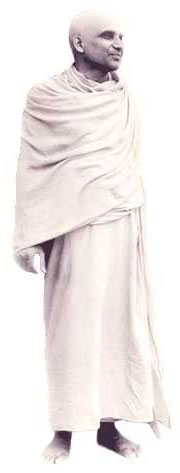
by Swami Krishnananda
The Divine Life Society - Sivananda Ashram, Rishikesh, India

1
1
Chapter 4: THE BHAGAVADGITA (Continued)
1
Yoga
 

In two terse verses, the Gita, at the end of its fifth chapter, says: "Shutting out all external objects; fixing the gaze between the eyebrows; regulating the harmonised currents of prana and apana within the nostrils; the senses, mind and intellect restrained; with moksha as the supreme Goal; free from desire, fear and anger;-such a man of meditation is verily liberated for ever."  

The sixth chapter is like a commentary on this aphoristic teaching. In its details, it is declared that no one will become a Yogi who has not renounced the desireful will. Though action is the means for one wishing self-purification leading to the state of meditation, the higher inaction of tranquillity of mind is the means to him who has attained to Yoga. He is said to be established in Yoga, who has no attachment either to sense-objects or to actions, and has no purpose to serve anywhere, being rid of all volitional motive. The Yogi should practise meditation on the Atman, retiring into solitude, with mind and senses subdued, and free from ambition and possessions. Having established a seat on a clean spot and placing oneself on it, making the mind one-pointed and subduing its activity and the rovings of the senses, let one practise Yoga for the purification of oneself. Let him firmly hold his body, head and neck erect and still, with gaze inwardly fixed and looking as if at the tip of his nose, and not glancing around. Fearless, being firm in the vow of Brahmacharya, the Yogi, always steadfast in meditation, attains to the peace residing in God, the peace which is at-one with final liberation. Yoga is not for him who eats too much or too little, not for him who sleeps too much or too little. Yoga comes to him who is moderate in eating and in recreation, in work, sleep and wakefulness. Establishment in the consciousness of the Atman is Yoga. This obviously implies freedom from all desires.  

As the flame of a lamp in a windless place flickers not, so steady is the mind of the Yogi practising meditation. Where the mind, completely restrained through the practice of meditation, attains quietude, and where seeing the Atman by the Atman, one is satisfied in the Atman; where one feels that infinite bliss, which is super-sensuous and is capable of being comprehended only by the higher understanding; established wherein one does not move even a bit; having obtained which one considers no other gain as superior to that; and wherein established one is not shaken even by heavy sorrow;-that state is to be known as Yoga, a state of severance from all pain. This Yoga has to be practised with determination, undisturbed by despondency or depression of spirit. When the mind moves away from the ideal for any reason, let it be brought under subjugation, gradually by bringing it back to the Atman, from whatever object it may be thinking. It is here that the Yogi beholds the Atman in all beings and all beings in the Atman.  

It is, however, to be reiterated that control of the mind is not so easy as one would imagine in a state of initial enthusiasm. It is turbulent, fickle, powerful and unyielding. It will not listen to threats and cannot be brought round by cajoling. Hard indeed is the task of the Yogi. But by practice (Abhyasa) and dispassion (Vairagya) it is possible to bring it to concentration on the Atman. An undisciplined and unprincipled person cannot hope to achieve success in Yoga. One who strives to practise Yoga is never a loser, but always a gainer, and even if he dies in his attempt, he will be reborn under conditions suitable for the continuance of the practice left unfinished in the previous life.  

It is the opinion of Krishna that even a student of Yoga is superior to an expert in theoretical knowledge of the performance of outward ritual. Though it may take, at times, several lives for one to reach the Goal of Yoga, there is no doubt that it is possible for everyone without distinction.

The Liberated Sage

The sage with spiritual wisdom, who is liberated from bondage is a Sthitaprajna (established in understanding), Gunatita (risen above the strands of Nature) and a Yogi (unified with the Absolute). He is not depressed in grief or exhilarated in joy, for he is free from desire, fear and anger, due to his understanding being fixed in God. Being devoid of personal love for anything, he neither welcomes nor abhors things when he comes in contact with them in the course of life. While his eyes are fixed on the world, his mind is fixed in God. In ordinary persons, the taste for objects persists though they may be physically absent in his presence; but in him, who has tasted the delight of the Supreme Reality, the taste for objects spontaneously vanishes. The senses, however, are powerful and they drag impetuously even a wise man's mind towards objects. It is necessary, therefore, to be perpetually vigilant in subduing the powers of the senses in contemplation on God. This is the condition of settled understanding. As rivers get merged in the ocean, desires get absorbed in a sublimation of the mind in Divine meditation. It is this inner state of composure that is called moksha or liberation from the thraldom of mortal life. With their intellects fixed in That, with their being absorbed in That, with their life dedicated to That, and depending on That alone, those, whose defects have been removed by the cleansing work of knowledge, reach the Eternal Reality. Seeing the diversity of characters, whether in a learned savant or a low-caste, a cow, a dog or an elephant, the sage of equal vision recognises the Divine Presence in them all, without disturbing the course of life based on such difference. Liberation is the attainment of equilibrium of consciousness and it can be realised even here, for Brahman is everything, and is everywhere. The pleasures born of contacts are wombs of pain; they are transient, and hence the wise one does not delight in them. One who has become Brahman attains to the beatitude of Brahman. He is the real Yogi, with inner delight and inner illumination, which lights up all the Universe.  

The sage is without hatred, and loves all. Firm in his resolution, he is yet possessed of the tenderest compassion. While wanting nothing for himself, he gives joy to all. He does not shrink away from anything, nor does he cause the world to shrink away from him. While doing all actions, he refrains from taking initiatives, for this is the business of God. Equal to friend and foe, in respect and censure, in heat and cold, pleasure and pain, attached to nothing in the world, speaking little, satisfied with anything that comes of its own accord, having nothing to call his own, steady in meditation on God - he is the sage who is freed for ever.

Death and After

The Lord assures that one who leaves this world, thinking of Him alone, reaches Him, in the end. One's future is governed by one's last thought, at the time of death. As this thought is, however, the cumulative result of what one has been thinking throughout one's life, it is to be understood that one's future life is determined by the nature of the present life taken as a whole. As a bitter tree does not bear a sweet fruit, one's last thought cannot be expected to be a divine one, if the life that precedes it is one of error and wickedness. By its fruit, we know the tree. Whatever one has been contemplating in one's life, that becomes the last thought which fixes the nature of the future life. Whatever one thinks deeply at the time of death, that one becomes in the next life. He who, by the practice of Yoga, meditates, in an undivided consciousness, on the Supreme Purusha, resplendent like the Sun, and thinks of Him at the time of his death, with deep concentration, devotion and power of aspiration, reaches Him, the Divine Being. In a concise statement, the Gita says that, by controlling all the senses, by centring the mind in the heart, by drawing the prana to the head, engaged in the practice of Yoga, uttering the monosyllable - Om the Brahman - and meditating on Him, he who departs hence, attains the Supreme Goal. There is no return to the consciousness of mortality (samsara) and pain after attaining the Divine Purusha.  

The Gita confirms the two paths of the departed soul mentioned in the Upanishads - the northern and the southern - in a more pithy statement of this route. The blessed soul moving towards its salvation is said to course through the Deities of Fire, Light, Day, the bright half of the lunar month and the six months of the northern motion of the Sun. The soul that is destined to return to rebirth passes through the presiding powers of the Smoke, Night, the dark half of the lunar month and the six months of the southern motion of the Sun. The Gita does not throw light on the apparently intricate meaning of these stages of the soul's movement after its departure from the world, and we are left in the same position as in the Upanishads on the subject. In all probability the Northern Path (archiradimarga) and the Southern Path (dhumamarga) are certain mystical experiences of the Soul in the subtler layers of the Cosmos, through which it traverses, determined by the spiritual and non-spiritual tendencies in it, respectively.  

In its classification of the three natures of the individual, the Gita makes mention of the fate of the soul in accordance with the predominance of the qualities of Prakriti operating in it. When, through every sensation or perception in the body or personality, the light of intelligence gets radiated, it is to be understood that Sattva is predominant in the person, and meeting death in that condition, one attains to the shining regions attained by those who are knowers of the highest Reality. When greed, restless activity, impulse to undertake initiatives, distraction and longing are seen in a person, it is to be understood that Rajas is predominant, and meeting death in that condition, one is born among those who are attached to activity. When ignorance, inertia, heedlessness and delusion are seen in a person, it is to be understood that Tamas is predominant, and meeting death in that condition, one is born in the wombs of the deluded and the irrational. Those who die in the state of Sattva go to the higher worlds of light. In Rajas the middle world of action, and in Tamas the lower world of darkness.  

But, when one beholds no agent of activity other than the properties of Prakriti, and knows That which is above the Gunas of Prakriti, one attains to 'My Being', says the Lord in the Gita.

The Spirit of the Bhagavadgita

The Gospel which Krishna bequeaths to humanity is not a cult, religion, or secret creed of any particular faith or community. It concerns not merely some remote otherworldly life, unconnected with practical activity here, but the whole range of experience, and lays down rules for systematic discipline. No aspect or phase of existence is excluded from the scope of the teaching of the Gita. Life is a process which is mysteriously connected with the Universe in all its planes of manifestation. The greatness of the Gita is in the integrality of its approach, the universality of its teaching and the all-comprehensiveness of its theme. The perfect person gives the perfect science of the perfect life. In this conversation between man and God, the hidden relations between them get unravelled and the glorious destiny of man revealed before his eyes.  

The Gita discloses the fact that the primary cause of the troubles in which man finds himself is the erroneous notion which he has about his relations with the body and the world, and in the end, with God. The perishable nature of the body, the changing character of the world and the immortal essence of consciousness are forgotten and man clings to the reverse of this truth, thinking that the body and the objects amidst which he is placed have a permanent value and that the Self is a dependent entity entwined in interrelations with things that seem to sustain it. Affection for the objects of the world strikes at the root of the peace that the soul is really seeking, for these loves of the world are false evaluations springing from ignorance. Buddhi or the higher reason should be used in distinguishing the truth and falsehood of experience. Often the reason in the human being is seen to work in cooperation with the senses and becomes their tool, carrying out the function of transmitting to the soul the characteristics of the objects as interpreted by the senses in terms of space, time and externality and degrading experience into body-consciousness. All judgment passed in this fashion is erroneous, as it does not take into consideration the fact of there being a unifying reality transcending objectivity. The higher knowledge comes to the aid of the human reason when the latter is purified by freedom from the shackles of the senses. The reason which reflects sense-experience is different from the reason which draws sustenance from the Atman within and commands the sense-powers, independent of spatial and temporal relations. Discrimination between the real and the apparent is possible only when the light of understanding is thrown on the facts and events which become its contents in experience.  

Cessation from physical action is not non-action, for one can be physically inactive and yet be performing actions in a different sense. Vital, emotional and intellectual action is real action. Cessation from actions like these would be real inaction. But man has no freedom to do this. Action is the law of all individual life. One is forced to act by the very nature of one's being. To maintain equanimity in the midst of such activity, one should work in a spirit of self-sacrifice, self-surrender, self-restraint and self-knowledge. The Universe is a living organism and every element in it tends to fulfil the law of its unitariness. The duty of everyone, therefore, is to be conscious of this organic structure of the cosmos and attune oneself to its way of working. The Yoga which Krishna teaches is spontaneous action based on the consciousness of the absoluteness of God, the surrender of oneself to God, or one's steadfast concentration on God. Negation of action is not possible, but one can neutralise the effects of action by transmuting it into Yoga. The benefits that one enjoys in life are the products of cooperative action from all things in the Universe and one cannot, therefore, afford to appropriate anything for one's own personal satisfaction.  

When knowledge and action blend into a single stream of concentrated force, when Krishna and Arjuna drive forward in unison, seated in one chariot, there are prosperity, victory, happiness and steady polity. 

  1
 
  Catalogue Search Site Map Contact
  Design by Savitr as a Love Offering