Search
 
 
Home swamiji Ebooks Articles Multimedia Uploads Catalogue Sitemap Contact


Ebook
 
In the light of wisdom

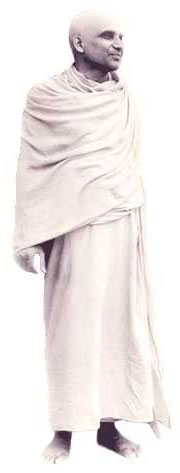
by Swami Krishnananda
The Divine Life Society - Sivananda Ashram, Rishikesh, India

1
1
Chapter 2: THE RIGHT RELATIONSHIPS BETWEEN THINGS (Continued)

Shall I tell a small humorous story? An old Swami told this story to me. There were two thieves. They were just moving about on a rainy night, and nearby some black thing was floating on the water. One of the thieves told the other, “My dear friend, it looks like a blanket. Why don’t you go and bring it? This is a cold night, and it will be helpful.” The other thief jumped in the water to catch the blanket, but he was struggling with it. He didn’t come back. Two minutes passed, five minutes, ten minutes. The other thief on the bank said, “If you cannot retrieve it, then leave it.” The thief in the water said, “I am leaving it, but it is not leaving me. It is a crocodile and not a blanket! I was trying to leave the ‘blanket’, but the ‘blanket’ is not leaving me.” It was a crocodile and he had mistaken it for a blanket. Likewise, we try to catch a blanket, but the blanket is catching hold of us. We cannot leave it, because it is catching hold of us so tightly. We begin by thinking that something is pleasurable because it is desirable—like this blanket business—but afterwards it assumes its true nature as a crocodile and catches us by the throat. We want to drop it, but it won’t let itself be dropped. It has become a part of our body, as it were, and it clasps its hands so tightly over our throats.

These ‘crocodiles’ are our pet desires, ambitions and cravings, sometimes acquired by heredity and sometimes they are newly created by our own wrong thinking and imaginations of the future. What a mess we have created in our minds. It should be very clear why we are unhappy in this world. We have a cloud of confusion covering the light of our minds, and we cannot see through this cloud properly. We try to see the world through this cloud of conflicts, but because we see unclearly through this mist of conflict, we see a world of conflict in front of us. The whole world is chaos. We begin to see that the world is not all right, because we see the world through this screen of darkness that holds sway over our own minds. This screen has become dark through many layers of conflict getting layered, one over the other for years and years together. Yoga philosophy and psychology tells us that we have been doing so for ages. We have passed through several births; we should not imagine that this is our first birth. We have been living through many bodily incarnations. Through the process of evolution we have come to this present level of the state of mankind. The layers of wrong thinking and unfulfilled desires are all there with us, which we have carried through the different incarnations of the mind.

Dispelling the Clouds

This cloud has to be dispelled; this is the purpose of yoga. When the clouds disperse, the sun shines automatically. In the same way, we need not create happiness—it is already there. Happiness is nothing but the release of these conflicts and tensions. You become the true ‘you’, and then you will know how happy you are. You must become the true ‘you’—not the untrue ‘you.’ The untrue ‘you’ is this cloud, this conflict—so many things and layers that we have created around ourselves. We have many layers of self—a communal self, a national self and so on. We say, “I am a Belgian, a German, an American.” This is the national self that is hanging on us.

Sometimes we belong to a community, and we begin to associate ourselves with it. We talk about it again and again, and we cannot extricate ourselves from the idea that we ourselves are a part of that community. “I am a Hindu, a Maharasthrian; I am this, I am that.” These are the communal selves . Then we have the family selves. We have got family names which are called surnames, and to each person a surname is attached. It is a family heritage. We have so many associations. Then come the personal associations of “I am a judge, a teacher, a businessman, a professor.” These are also selves we have created, but they are false selves. Socially also we have created these false selves. As if the inner problems were not sufficient, we have created additional problems by adding all these from outside. Inwardly there are also many layers; I shall touch upon these inner layers a little later on. Layers and layers of self are covering the true self. Like layers of clouds can make the sun dark, layers of the false self have made our true selves a mass of darkness, confusion, and therefore unhappiness.

In the previous chapter I was trying to give a broad outline of the basis on which doctors of psychoanalysis work, inasmuch as they feel that there seems to be a conflict between the inner ideal and the outer reality of society, which has become the cause of mental sickness. Health would be assured if this conflict could be resolved by the bringing out of these buried ideals into the daylight of outer life. Then the conflict would be resolved and the person would become happy and healthy. This is a simple analysis of the science of modern psychology and its therapeutic techniques. But the question is whether this society is a reality by itself. Are we going to be perfectly normal and wholly happy merely because our inner ideals and desires have been set in tune with the outer society, which we have been regarding as reality?

For psychologists, reality means the social world—we must be in tune with the world outside. For us ‘world’ means mankind. The world of human beings is called the world as far as we are concerned; we are not concerned with the astronomical world, that does not worry us so much. So if the world of human society is to be regarded as the reality, then the attunement of our minds with it should assure us human happiness. But we saw in our earlier discussion that this is not the case. People who are well off in society are not always found to be happy. They have a secret problem which they cannot understand or much less explain.

Yoga began to contemplate the mysteries behind the phenomenon of unhappiness persisting in spite of one’s having everything in life. We may be the king of the whole world, yet it is doubtful if we are going to be happy; we will have many problems. What is above this world? Why not conquer that? Maybe we have ambitions. Desires cannot be overcome even if we were the kings of this world. Death will come to us when it is time to leave this world. These are important difficulties of a person, even if he is the emperor of the whole world. How long are we going to be the emperor? It may be for a few hours. We may be asked to quit this world to a place of which we have absolutely no knowledge. Do we know when we will have to leave this world? Do we know where we go after leaving the world? No! What a pity, we do not know when to leave this place, and we do not know where we are going. Can there be a worse suffering than this? Yet, we seem to be cosily imagining that everything is okay. In a state of intense ignorance, we may be in a state of bliss. This is also a kind of bliss, as not to know anything is also bliss. That seems to be our final resort.

”But is this fair?” was the question of the seers who saw into the depths of things. They did not see empirically, but in another way altogether. The empirical method does not succeed, because it is unable to link up one thing with another causally, and it does not see through to the ends of things. The empirical method of observation is an external observation of an outer world which has no end at all. How long can we go on peeping through our telescopes? The world has no limits. There are two difficulties in the empirical approach. One is that there is no end to things; however much we may probe, there is something lying beyond what we can see. That is one problem. The second is that we have not seen the truth of things—we have only seen the shadows of these things, only their outer crust. Just as when we look at a person, we cannot see the true self of the person and see only the outer self. Like that, there is a put-on appearance of things which we see through telescopes, microscopes, etc. Qualitatively as well as quantitatively there is a failure in the methods adopted in empirical psychology. Yoga discovered that this is not the way, and we ought to find another way altogether. There is no use merely trying to look at things either through the microscope or the telescope; we have to see through them.

What is the difference between ‘looking at’ and ‘seeing through’? They are quite different things altogether. The inner stuff of things has to be seen. We ought to see the object, the thing or the person as it is in itself or himself. There is no use in gathering information. Glancing over something—this is not knowledge. Yoga psychology is based on a philosophy that commenced with the observation of the fact that there is a deeper conflict in nature than the mere psychological conflict in the mind of the human being. This psychological conflict seems to be based on another conflict which our psychologists do not know. Why should there be this conflict of the ideal with the real? It is due to another, deeper conflict. Here we have entered the philosophy of yoga. There seems to be a conflict between the individual desire and society’s ideal, because these two seem to be irreconcilable—one going one way and another going the other way.

There seems to be a fundamental conflict between man and nature. The conflict between man and society is small when compared to this conflict between man and nature. There is a larger conflict of the irreconcilability between man and nature, because we do not know what this huge cosmos is. Inasmuch as we have not been able to answer this question of the relationship between us and this cosmos, we have not been able also to answer this question of our relation with human society. What we call human society is only a small fraction of the vast universe before us. Just as a finger is a part of a person’s larger body, this so-called society which is apparently troubling us so much is only a part—a very small part, insignificant perhaps—of this vast and magnificent creation. It is creation that is posing a problem, not this small human society. The problem of society is a part of the problem of the world as a whole.

We might not have had the occasion to pose this question, because the small problems were engaging our attention so much. The person just beside us is causing us so much annoyance that we have no time to think of the larger difficulties in life. A person just near us is a problem for us, and we do not know how to deal with him. Our neighbour himself becomes a problem for us. Where is the time to think of the vast world outside? A great principle of philosophical analysis is that, unless one goes to the cause, the effect cannot be known. Our neighbour, the person near us, is only an effect of a larger cause. We cannot do anything with our neighbour or the person near us, because he in the position of an effect. The person near us is not the problem—our intelligible relationship with him is the problem. The relationship between us and the neighbour is so nebulous that it becomes a problem, and we cannot solve it.

This is an effect of a larger question, which is the cause of all problems. The whole situation can be summed up in a single question, “What is our relation with the environment in which we are?” The environment is so big; what is our relation to it? What is the relation between man and nature, the inner and the outer, and the individual and the cosmos? If this question can be answered, all other questions in the world can be answered—the small question of the relation between the employer and the employed, the master and the servant, the husband and the wife, the parent and the child and so on. These are all small questions arising out of this big question of our relation to our environment.

Adhyatma and Adhibhuta

Can you remember two Sanskrit terms? The inner and the outer are signified by two technical Sanskrit terms—the adhyatma and the adhibhuta. I won’t use many words in Sanskrit, but these are very important ones. Try to remember them. The adhyatma is the inner, the adhibhuta is the outer. What is the relation between the two, and what are the meanings of these words? Adhyatma is that which pertains to the Self. Atman is the Self, you know. What is the nature of the Self? Let us not worry about that now. Adhyatma is that which pertains to the Self; adhibhuta is that which pertains to the world of objects. Put in metaphysical language, what is the relation between the subject and the object? While we have concentrated all other questions into this basic question of the relation between the subject and the object, we seem to be confronted by another difficulty, namely, the meaning of ‘relation’ itself. What do we mean by ‘relation’, or ‘the relation between the subject and the object’? That is the question no doubt, but what is ‘relation’? How do we explain relation or define it? We may say a relation is a kind of connection. We think of connection in the sense of links of a chain. For example, one link is touching another link, that link will touch just another, and so on forming a chain. This is called relation, as far as our minds can think of it. But relation is not so simple as that.

We have been just glibly talking about relation. In this sense, when I touch this desk, my finger is supposed to be in relation with this desk. The question then becomes, what is ‘touch’? Is my finger really in relation with this desk? Is a link in a chain really touching another link? We may say, “Yes, it is touching,” but what is this touch? Does one link enter into touch with another link? Is there a relation of one link with another link? In a chain, does one link enter into another link, or does it lie outside another link? It does not enter—it remains outside. In a relation of this kind, which is perhaps the larger amount of relations in the world, the connected items lie outside each other. The child may be related to the mother, but it does not enter into the mother, or the mother does not enter into the child. They are outside each other and exclusive, even though the child may be so near the mother that she feels it as an inseparable part of herself. Yet, one is outside the other.

Exclusive relationship is the so-called relationship of most things in this world. That is why, though things seem to be related to one another, sometimes they depart from one another. There is then bereavement, separation and agony of various kinds. Friends turn away from each other. Relations—the very dear kith and kin—leave each other. There is separation of various kinds, and finally there is death. This relation of one thing with another does not promise actual connection between one object or person and another, because the related terms have not entered into each other. They have been always lying outside each other, and their relationship has been psychological rather than factual. There is no factual relationship between one link and another. There is a temporary, utilitarian or practical relationship which works through life. Something may work in some way, but it may not be the ultimate fact.

We have a working knowledge of things, as people say. We do not have a real knowledge—just a working knowledge which goes with life. We have been getting on with things through various kinds of relationships. The adhyatma and the adhibhuta, the subject and the object, man and nature, have been in this sort of relationship—not really related, but only apparently connected. So we have not been able to know what to do with this world. Nature has always been lying outside us. It has never become a part of us; it has never become ours. We have never been able to control or master nature fully, because it was always something different from us, and not ours. Ever since creation, this has been the situation. We have never been able to possess a thing properly. If we could possess it really, why should it leave us after some time? We lose things, as we say. Why should we lose a thing that is really ours? The reason is that it is not ours. We have been thinking that it was ours, but it asserts its real nature of not being ours when it leaves us. “I am not yours, my dear friend. Don’t think I am not going.” Things may leave us; it may be a person, it may be our own relationships, our own possessions—whatever it is—all that we possess may leave us.

We may be thinking that it is ours, but a time comes when those things assert their independence. “Oh, we are absolutely independent, just as you are. You think that we belong to you, as well as we may think that you belong to us. Why should I belong to you, sir? Why shouldn’t you belong to me?” Why do we say some objects are ours, some persons are ours? What makes us think like that? The others also may think that we belong to them. Instead of other things belonging to us, we may belong to something else. There is a relativity of belonging and relationship. Sometimes we are told that this is the world of relativity, one thing hanging on another and nothing absolutely independent by itself. We hang on something else; that thing hangs on us. This is a simple, crude explanation of the relativity of things, which we will look into in the next chapter.

  1
 
  Catalogue Search Site Map Contact
  Design by Savitr as a Love Offering