Search
 
 
Home swamiji Ebooks Articles Multimedia Uploads Catalogue Sitemap Contact


Ebook
 
In the light of wisdom

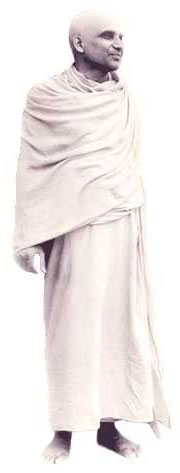
by Swami Krishnananda
The Divine Life Society - Sivananda Ashram, Rishikesh, India

1
1
Chapter 13: THE NECESSITY FOR YOGA (Continued)

We have to remember that there is a vast universe around us, wider than the population of the world, and we cannot completely ignore it in our consideration of our environment outside. To yoga, the world is not mankind merely, and not humanity. Yoga also considers the world in its creational aspect. One may say that yoga psychology is more metaphysical than it is simply human. In one sense we may call yoga “metaphysical psychology”, in the sense that it goes into the fundamentals of things as they are and not as they merely appear to us. Social adjustment may be a need, but adjustment to the world is something which should be regarded as a greater need.

With this foundation, yoga tries to build up the structure of its practice. The psychology of the mind in its relation to other minds is different from the psychology of the mind in relation to existent things as they are. Generally, what we mean by psychology is mental reaction to other minds—especially human minds. But what is the mind’s reaction to other things of the world? These things also exert an influence upon us.

The objects of perception are the concern of yoga psychology—not merely the minds of other people. The reconciliation of the mind with its objects is the foundation of yoga psychology. This reconciliation has been attempted by the Samkhya, and it also did not succeed. The reconciliation was not practicable because of the conflict between the purusha and the prakriti of the Samkhya. On one side there is the infinite consciousness of the purusha, on the other side there is the infinite prakriti or matter. There was a gulf between the two, and one stared at the other without being able to touch the other. If prakriti gazes at purusha and the purusha gazes at prakriti, and one will not come in contact with the other, what is the relation between the one and the other? There Samkhya ended in a particular philosophy of its own, into which we need not enter now.

Yoga psychology realised that, notwithstanding this metaphysical dualism of the Samkhya, a kind of freedom for the purusha could be achieved if it could understand its true relation with prakriti. Consciousness can appreciate its relation with matter. In our analysis of perception done earlier, we went beyond the gulf in the Samkhya between purusha and prakriti and discovered a natural relationship of consciousness between the subject and the object. It appeared that a proper reconciliation between the subject and the object would be impossible without delving into this consciousness which is between the subject and the object. Yoga psychology therefore is based upon the acceptance of the fact that the gulf between the subject and the object is not final, but it can be resolved through adopting a means higher than that available merely to the individual mind. It is a means which seems to have connection with a deeper nature of the individual—the true Self of the individual.

All lower conflicts can be explained only by the higher reconciliation. Nothing that is visible before our eyes and nothing that we think in our minds can be resolved or understood properly without reference to a realm above, higher than or deeper than the mind and the senses. Thus, we philosophically conclude that the practice of yoga should finally be based on a reconciliation between consciousness within and matter without. It may also be the point of the Samkhya, namely, the reconciliation between the purusha within and the prakriti without. Man and nature have to be reconciled—they should not create a jarring noise between themselves, they should not clash, and they should move parallel with the same speed and with adequate understanding of each other.

If nature and man, the object and the subject are to move parallel, at the same speed, and in the same direction, there will be no conflict, and the world would then be our friend. But if the world moves in one direction and our minds move in another, there will be no parallel movement in us, and we are not going to be reconciled. The world is not going to answer to our needs. Now, the question is, is the world going to follow me, or am I to follow the world? Who is to lead, and who is to follow? Man, in his egoism, feels that the world should follow him. This is the dictator’s attitude, and we know what happened to the dictators. Not one of them has survived, because nature has no ego, and it will not tolerate an ego. The ego will be subjugated one day or the other. Man cannot bring nature down to follow his ego. The egoless condition is superior to the egoistic condition, because the former is more general, while the latter is special and particularised. While the former condition of egolessness is applicable in all conditions, the condition of egoity is applicable to individuals alone. The special has to subsumed into the general.

Man has to obey nature, for nature will not obey man, and a proper settlement between the two must be arrived at if both are to exist and function at a common level of reality. At present, the levels of reality between the two are poles apart. The conflict between man and nature has been caused by the ego of man; but if ego is removed, nature fuses itself into man and man fuses himself into nature. There should be nothing to prevent this union. Two egoless beings will cease to be two beings—there will be only one being. While two egos try to repel each other, egoless beings try to unite with each other. When man becomes egoless, he becomes one with nature outside, and he becomes as powerful as nature itself.

The Psychology of Yoga is the Fundamental Science

The harder the ego, the weaker is the person, because the more he is remote from the natural powers. The most egoistic of people are also the weakest. They may assume an attitude of power and confidence, but nevertheless they can feel threatened from any side. The lesser the ego, the more powerful and confident we feel, because of our being backed up by the natural forces around us. Therefore, the path of yoga is to diminish the ego, so that it may become in tune with the egoless condition of nature. The individuality should become more and more ethereal, thinned out and capable of attunement with the egoless condition of nature. The object before the mind is not merely one local body like a mountain or a tree; the object is all things that are in front of us. The whole of nature is our object, and all the small bodies are only parts of it. The mountains, the rivers, the trees, the plants and the many things that we see in front of us are nature gazing at us from different directions. Nature in its totality is our object. Man’s mind has only one object, not many objects. We have to confront only one thing in the world and not many things. The whole creation is a single object which is operating with its many hands; but they are only hands—the body is one. The five elements, the astronomical universe in front of us, and even the bodies of personalities—all these are only arms of a single nature spread out everywhere.

We have to confront nature in its completeness and not try to confront this person, that person, this body or that body. This is not going to satisfy us. In that sense, the psychology of yoga is more all-encompassing than the general psychology which is studied in schools and colleges. Yoga is a psychology of the mind in its relationship with a universal object, and it does not deal merely with the relationship between this object and that object. Hence, it is the study of fundamental problems of human nature. If these problems are studied, we study the problems of everyone in the world—mine, yours and everybody’s. The psychology of yoga is the fundamental science, and it is the gate to open up the mysteries of nature itself.

Yoga meditation, which is the actual practice of yoga finally, is a development of the psychology of yoga and a blossoming of its psychological investigation, we may say. We cannot practise meditation unless we are an adept in this psychology. There is no use in merely closing the eyes and meditating when the mind is not prepared for it. The mind in all its functions, including the function of meditation, is backed up by a power within. In ordinary life the mind is pushed by a longing for satisfaction of its desires, but in meditation—which is the highest reach of yoga—it is stimulated within by a universal longing for Self-realisation. In this stirring up of consciousness towards a meditation on reality, there is a contribution made by every part of nature. Friendship and co-operation come to us from nature from every side.

In the same way, when opposition comes from nature, then it will also come from every side. When nature opposes us, we will find ourselves in hot water at every moment. Wherever we look we will find problems, difficulties and troubles, if nature starts opposing us. We cannot place our foot in this world when nature is against us, but if it is co-operative, we will find heaven everywhere. This is how nature works—for or against. It is like God Himself working. If God opposes us, the opposition will come from ten directions, but if He starts helping us, He will provide us with bliss from ten directions. We can imagine how difficult meditation is, given that nature is our object of study and analysis and that this is the foundation of yoga meditation.

Let go of the idea that meditation is a simple affair. On what are we meditating? Who is our object of meditation? We cannot engage ourselves in a meditation of any kind if nature is against us—it will put an end to our meditation in a minute. Meditation may not succeed unless we are co-operative with nature and friendly with it, and only then will it permit this function of our minds to proceed in meditation. We need to have a thorough understanding of what this meditation means and what we are supposed to do, and only then can the practice of yoga advance.

The act of meditation, which is real yoga, is a function of the mind in its relation not only with our individual personality and society outside, but also in its relations with the world as a whole. The psychology of yoga is very interesting, but it also requires in its studies a very careful attention to the mind. We are not studying in this psychology a particular mind, but “mind stuff,” which means in its generality “chitta.” It is the usual term used in yoga to signify the stuff of the mind, rather than solely the mentation of the mind. In this psychology we are not merely studying thinking, but rather the mind stuff itself. It is the substance of which our psychological organs are made—the stuff of the mind which is in relation to the stuff of the universe outside. This chitta is not just thinking connected with one person or thing outside. The substance of our minds is in conflict with the substance of the world outside, and so the substance within has to be brought into reconciliation with the substance without. This is the purpose of the psychology of yoga. We now know where we stand when we are a student of yoga.

It is not a joke—it is a very serious matter, and nothing could be more serious in this world. We know what things we are dealing with in yoga and how we are to understand ourselves and what confronts us outside. What our problems and difficulties are should be clear to our minds. Yoga is something more momentous than any other thing in this world. Yoga is not one of the duties or the functions of a person, it is the only function of a person—nothing can be as important, and everything else comes afterwards. All other things pale in significance, considering the importance of yoga. When we understand this properly, everything else becomes meaningless, relatively speaking. All functions, performances, duties and all commencements in life come afterwards, because all these become insignificant when compared with the importance of this supreme enterprise of the human mind in yoga.

Yoga is not a hobby. We may try it and leave it, or try to go without it, but we cannot go without it. Yoga is not of the East or the West—it is of everybody. It is not of a man or a woman, it is not of this age or that age, and it is not merely local. It is the law of the cosmos that we study in yoga, and who can exist without it? Can anyone afford to be without it? One can imagine what yoga is and what it means to mankind and the world. This should strengthen our personality and give us confidence, because we are dealing with realities and not with phantoms. At the same time, yoga gives us an idea of the ways of approach in life.

All this should remind us how cautious we ought to be in yoga. We are dealing with a thing which is everywhere around us. If people are surrounding us in all directions, we are more cautious in dealing with them than when there is only one person in front of us. Let there be no misapprehension that we are dealing with this object or the other object in yoga. We are dealing with a force rather than an object—a force which is in all directions—and a force which is also within us. Yoga is a study of universal force and a realisation of it in practical life. For a few minutes at least each day we should close our eyes and contemplate this truth.

  1
 
  Catalogue Search Site Map Contact
  Design by Savitr as a Love Offering