Search
 
 
Home swamiji Ebooks Articles Multimedia Uploads Catalogue Sitemap Contact


Ebook
 
The vision of life

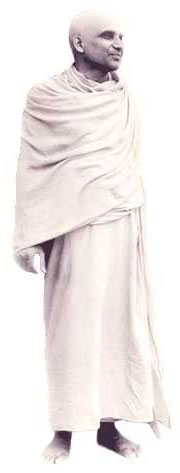
by Swami Krishnananda
The Divine Life Society - Sivananda Ashram, Rishikesh, India

1
1
Chapter 4: UNIVERSAL VISION (Continued)

All this is to give a brief notion as to what dharma could be as a cementing factor between the objects which are the artha and the kama that calls for them. Dharma points to a freedom of the calling nature from the clutches of the objects, and also the impulsion of the call itself. We are bound in this world in a twofold way—by the pressure of the call for things arising from our own individualities, and also by the magnetic pull that is exerted by the objects themselves. To put it in the language of the Upanishads, they are atigrahas—greater catchers or grabbers.

We cannot actually know what is happening to us merely by thinking through the mind or rationally arguing in an empirical fashion through known logics of the world. What is happening to us? Why are things what they are? Why should the world be exactly as it is, visible or seen? Why is this creation made to appear before us in the manner it is? Why are we happy and why are we unhappy? Why do we want this and why do we not want that? Why there is a desire to live long and why do we fear death? What is the matter with us? Why this confused medley of adjustments and maladjustments in life, keeping us in a state of anxiety from moment to moment, no one knowing what is actually happening and no one knowing what one really needs in this world?

This great difficulty, this intense question that is raised about ourselves, namely, what life itself is—this question cannot be answered by anyone who raises this question, because the answer comes from a state of existence which is behind and beyond the state of affairs which evokes such questions. It is the wish that is inherent in every living being, basically uniform in its nature and arising from the deepest recesses of the being of anything; not capable of satisfaction through possession of things, artha; not being exhausted by the calls of the psyche called kama; not being able to be wholly satisfied even by subjection to the law called dharma—a call that is inexplicable, cannot be identified with either the action of law in the world or with the presence of things that are desirable, much less a desire for things. This inscrutable, unknowable, unimaginable, inexplicable, unanswerable position that life seems to be occupying is the great answer of life to the question of life—briefly, in an enigmatic manner, called moksha or freedom.

It is freedom that is at the back of the desire for the possession of artha or objects. We are subjected to a pressure which arises from our desiring nature in respect of things that the desire actually expects from the outside world. We are subjected to the pressure of these inward calls. This is not freedom. To be subject to an inward pressure in the form of a desire is more a slavery than an act of freedom. It is not that we are freely asking for things. We are not exercising freedom when we desire an object. We are exercising the opposite of it—subjection to the pressure of desire.

Even when the objects which the desires expect for their fulfillment are presented to us, we are subjected to another kind of pressure, namely, the endlessness of the objects that the desire is actually pointing itself to. The endlessness of the variety of things in the world is also a difficulty that is posed in having to find satisfaction even when the desired object is presented to the desiring individual. The whole ocean of objects is there in front of this desiring individual. There is, therefore, limitation on one side in the form of a pressure felt in the form of desire, kama, and on other side there is a greater difficulty in the form of a sea, as it were—a sea of objects appearing before the sense organs. On either side there is no question of voluntary action or freedom in the true sense of the term.

The real freedom that one is expecting from the satisfaction of sense objects is not coming forth because of the difficulties mentioned—the impulsion that is unending from inside and the unending expanse of the objects of the senses from outside. What is the solution? The solution is in the acceptance of the fact that freedom is the nature of life, and it is quite different from any kind of externalised achievement or psychological operation—it is freedom from the desire to contact anything at all. The freedom that we seem to be enjoying by coming in contact with things outside is not freedom. Freedom is the end of the desire itself. When we feel free because we have what we actually wanted, we are not actually free. We are free only when we feel that we need nothing. So the freedom of the soul is not in the acquisition of objects; rather freedom is in the state which needs no contact with objects.

How can freedom be identified with a state of affairs where there is no necessity to come in contact with anything at all? This is so because of the fact that the world is not constituted of objects. The nature of the world in which we are living is not actually externalised, but universalised. The world is the creation of God. We hear it said in the scriptures that the Lord Almighty has revealed Himself as this creation. God, who is all-in-all, all complete, inexhaustible infinity has manifested Himself as this cosmos.

Infinity has moved into the form of another alienated infinity, as it were, through a process which also is infinity itself. This great bundling up of infinities, one over the other, piling completion over completion in an inscrutable manner, is what is indicated by the great mantra of the Brihadaranyaka Upanishad which proclaims: Purnam adah purnam idam purnat purnam udacyate; purnasya purnam adaya puram evavasisyate. The Full that is the Almighty, in an act that is Fullness in itself, produced a Fullness that is called the universe, so that the Creative Will, which is Full, does not in any way get diminished in its Fullness of content by the projection of another Fullness which is the universe or even its act of creation, the process of the manifestation of the universe—even that does not become in any way less than the Full.

The measure or the step that God seems to be taking in the creation of the universe is also completeness in itself. It is an inward self-fulfillment of the great completion and the grand fulfillment which is the aim of all existence; that is the meaning of this ‘Purnam adah purnam idam’ mantra. Such being the case, nothing that is partial, fragmented, or localised can satisfy any localised individual. Dharma, which is all inclusive in its action and tries to bring all things together for the purpose of a fulfillment of all things, is actually God working. Dharma is God Himself acting in the world. In the Vedas, a special term is used for the manner in which this law operates. ‘Rita’ is the term used—the cosmic law. In the Bhagavadgita this is designated by another term called ‘visarga’. The projection in a wholesale fashion of a Whole that is the universe, from a Whole that is the Creative Will, is the final meaning of the dharma of the universe—an eternity manifesting itself as inclusive temporality. Even time, which is segmented as the past, present and future, appearing to be limited because of the historical process through which it passes, is actually a completion in itself.

All creation is self-filled. This self-fulfillment, the necessity to assert a completion even in the littlest core of creation that is felt in direct experience, is the consequence of a universal present in all particulars. Even in the smallest creature we find a wholeness that is operating, a tendency to feel that it is all-in-all. A little crawling ant is not a fragment of life—it is a complete being, self sufficient, all-in-all, very happy, needing nothing outside itself. So is the minutest of creation, even an atom which tries to maintain its stability by an action around itself through the nucleus which is its core. This fulfillment is God reverberating through minute, more diluted forms of fulfillment, through the gradations of creation, until it reaches the lowest level called atomic existence, which also is fulfillment by itself.

The whole thing is completion, fulfillment—purnam, purnam. All is complete. Fragments are unknown. Even so-called isolated, neglected fragments of material values are also fulfillment in themselves. It is complete. This assertion of a sense of self-sufficiency and self- completeness in all things, though appearing to be minute in their quantum, is a reflection of the wholeness that is directly acting, eternally, in all things. The action of God is eternal action, even while it appears to be a temporally manouvered operation.

So, moksha is the soul, and dharma is the action of this universal soul. Satya, which is the eternal state of utter liberation or moksha, acts in this world as rita or the law of the cosmos. Embodied moksha is dharma. The soul of dharma is moksha, which, when it appears as something segmented in the subjective or objective side, appears as individual desire on one side and objects of senses on the other side. The total universality, which is God Almighty, Supreme Absolute—Brahman, we may call it—looks like an object, adhibhuta, externally conceived as the material universe, and adhyatma or the individual from the subjective side. The segmentation of this whole into the knowing side and the known side is the reason behind the desires of life. The action of dharma adumbrates that the desires so manifest from individual centres in the direction of objects outside is a misconstruing of things. Any kind of law in this world is a pointer to the inadequacy of the manner in which individuals act in relation to other individuals from their own point of view. Social law, political law, economic law, psychological law or any kind of institution of order or system is indicative of the fact of there being something inherent in the so-called fragments of individual isolated existence, of something which is more than the individual.

Life, in any of its formations, is just the assertion of the universal in the individual—a transcendence working through that which is acting, for all practical purposes, from one place only. Location in space and limitation in time is not all. This location is inexplicable unless it is defined in terms of other forms of location. You will see that no individual existence can be permitted finally. No one can survive unless there is a cooperation with other individuals, which means to say even the so-called asserted individual existence is really something beyond individual existence. This is why social formations are required —individuals love something more than themselves. It is impossible to be limited only to one’s own self. Such a thing is impossible. There will be a withering away of the individuality if an extreme affirmation of that individuality is maintained irrespective of its relationship with other individuals. The cooperative coming together of individuals, socially, is the affirmation of a larger-than-the-individual acting in the individual, namely a universal principle. Therefore social law is supposed to be more respectable than merely an individual law. The larger is the operation of this law, the more respectable it becomes, the more endurable it is and the more valid it is, until these operative laws, rising from the individual to larger dimensions, reach a climax where these laws comprehend every law altogether. The law stands as the only operative law, and nothing outside it can be there. It is a law that need not be amended at any time, because it is eternity masquerading in time.

The concept of the values of life—which is dharma, artha, kama and moksha—is a masterstroke of genius of the Indian soil particularly, which did not exclude from its consideration even the lowest calls of human nature, but was not satisfied with any of the calls of human nature. While all our desires are permissible in one way, none of the desires is finally permissible. While all that we need and call for, and every thought, every feeling, every vision of life is a permissible and valid evaluation of things from its own point of view, none of them is final. All phases of the vision of life are valid from their own points of view. Every religion is a right religion, a correct vision of things, and every faith is valid in its own way. Every vision is complete, every viewpoint has a validity of its own and anything that one thinks is a valid thinking—but it is an inadequate thinking.

Here is the necessity for charitableness, which we have to manifest in ourselves while affirming our own point of view. My point of view and your point of view and everyone’s point of view is a correct point of view, but none’s point of view is a whole point of view. There is something beyond any vision of things, though every vision of things is self-centred and appears to be complete from its own stage, level and operative angle. There is thus a necessity to live a cooperative life. The life that the world expects from us is not so much competitive as cooperative. Things in the world do not argue, one against the other. They do not compete in a business fashion, but agree to accept their own limitations, and also agree to expect the correlative aspects of their inadequacies from other things in the world, other people—from everything. Everyone is sacrosanct, everyone is holy, everyone is complete, and every human being is as valuable as any other human being. Everyone is equally valuable—there is no inferiority or superiority among people. Human life is a ubiquitous, equally distributed valuation of aspiration to exist, but no individual human life is complete in itself.

This is to sum up the viewpoint that is placed before us by the pattern called the fourfold purusharthasdharma, artha, kama and moksha. They are not four aims of existence; they are the fourfold vision of a single aim of existence. We are materially located in this body, we are psychologically operating through the mind, we are socially existing in the midst of people, and we are also vehicles of an eternity that is permanently acting for the fulfillment of itself in self-realisation.

So the artha that is the objective world, the kama that is the psychological asking, the dharma that wants to keep everything alive in a cohesive manner—all these are fingers operating in space and time of a non-temporal Eternity whose names are the objects of adoration in the religions of the world. Religions therefore are various roads that lead to this centre, the peak of eternal life—we call it moksha in our own language. But what moksha is, is something that still remains eluding to our mental grasp. Even after having said so much about it, it remains an inscrutable something. Whatever idea of liberation, freedom or moksha we may entertain in our minds, finally we will find it to be a wrong concept. It is impossible in our own psychological limitations to entertain a correct idea of what true freedom is, what eternal life is, or moksha is, or for the matter of that, what we are actually aspiring for at all, in the end, in our life. This requires great discipline, a peculiar training which is called sadhana marga, the path of spiritual practice, which makes us fit recipients of this eternal blessing that is flooding us from all sides—a call from a central parent, a father and mother to whose calls we are sensorily deaf and psychologically blunt, not sharp enough to receive its call. Spiritual life is not a philosophical theory, it is not a view of things, it is not even a religious ritual or performance—it is an actual living of the very soul of what we are in utter practise. It is living and not merely thinking.

The presentation of the fourfold facet of existence as dharma, artha, kama and moksha does not stand as four legs of an aspiration, but actually means the variety of fulfillment through the various degrees of our ascent in life to finally get fulfilled in a thing that we cannot think at the present moment through our feeble minds.

  1
 
  Catalogue Search Site Map Contact
  Design by Savitr as a Love Offering