Search
 
 
Home Swamiji Ebooks Articles Multimedia Uploads Catalogue Sitemap Contact


Ebook
 
THE teachings of the bhagavadgita

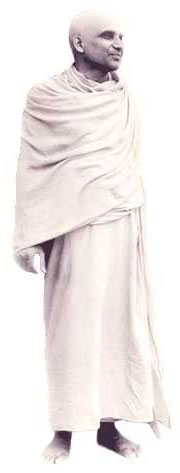
by Swami Krishnananda
The Divine Life Society - Sivananda Ashram, Rishikesh, India

1
1
chapter 4: DUTY - An Empirical Manifestation of True Being (Continued)


Kama is a very wide word, with a meaning which is capable of covering every form of longing. When desire intensifies itself, we call it passion. In Sanskrit we have many words indicating the same meaning: raga, kama, etc. An intense longing for something, an intense craving to do something, a yearning to possess something in an overwhelmingly powerful manner, is a passion - a kama, a raga. Any obstacle in the direction of the fulfilment of this passion becomes the target of anger of that person. Krodha follows therefore, as a brother of kama - and when one is, the other one also is. These impulsions are the products or the results of a very active manifestation of rajoguna - rajas - that is present in human personality, and no one can subdue them, normally speaking. A higher meditative technique may have to be employed, and there is no other recipe for this illness of man. The meditational technique that is very, very precisely stated in only a few words towards the end of the third chapter is to be dilated upon further on when we go to the fourth, fifth and sixth chapters, indicating thereby the lower can be controlled only by resort to the higher. You cannot employ lower means to restrain these lower impulses. Only a greater force can control a lower force. The reason has to be trained, for a long time, in carrying on correct judgment of things, so that the emotions may not preponderate and take advantage of the position when the reason is out of guard sometimes.

The Bhagavadgita will tell us in a half-sentence, as it were, towards the end of the third chapter, that the final panacea for this great illness of man is only refuge to the great Atman or the Self that transcends even the reason of man. This is like a theorem that is being stated, whose explanations have to be provided for a little later. Yet, man seems to be helpless. There is a subtle feeling in every one of us that in spite of this glorious teaching, we seem to be somehow helpless, in some mysterious manner, and we cannot entirely be confident that we can be successful in this great adventure of the putting into daily action of this philosophical principle.

There is a subtle weakness in man which speaks in its own language, and whispers in a tone which is distressing at moments. "After all, you puny fellow, you cannot achieve this glorious, cosmical success. Though it may be true that there is some heritage in you, at the present moment all this is like a phantasm, and you should not be under the impression that you have the strength in you to face the storm that the world may kick up when you actually tread the path of the spirit." And each one knows one's own weaknesses; each one knows to what extent one can understand things; each one knows one's own strength, capacity - but, each one knows also one's own weaknesses. Oftentimes, the weaknesses may outbalance our strengths. This is a suspicion that may be in our minds, and "Doubts are our traitors," says the poet. The traitor in us is the doubt that we are incapable of achieving this perhaps - there is perhaps something due to which we cannot achieve success in this path. Though we may not know what is the reason behind this feeling, that feeling is there, and the feeling has a reason of its own which reason cannot know. "Whatever you may say, I have something to say, finally, and this is this." This is very unfortunate. This doubt may arise in the mind of Arjuna that, "After all, I think I'm not for this." Many seekers, ardent students of yoga, may receive a setback in their practice, and receive such a blow from outward society and nature and even the physical personality of one's own, by illness or other conditions, that one may be disappointed to the core and throw the bow and arrow down - "This is not for me," as Arjuna did. All these tools and implements that you have gathered for the practice of yoga psychologically will be cast aside. "I'm fed up. I've done so much, but I've achieved nothing." Let this doubt not enter your mind! "O, ye of little faith," says Christ, "if you have faith as much as the size of a mustard seed, tell this mountain to move and it shall be cast into the ocean, but have faith at least as the size of a mustard seed." This is the great solacing message of Christ; and Krishna said the same thing many, many centuries back, before Christ was born. This was told us that confidence is that which will pave the way to success. Never say that "I am unfit." Why should you not be fit? "What one has achieved others also can achieve," is a sentence often repeated by Swami Sivanandaji Maharaj. If one Shankaracharaya could have achieved that, why not you? In what way are you less? "If there was one successful adept, why should I not be successful? If he has succeeded, why I should not succeed? If he could overcome all the obstacles, why should I not?"

This solacing message of hope, and not of despondency, is accentuated and re-enforced at the commencement of the fourth chapter, where the Lord declares Himself as ready to help anyone, at any moment of time, by an incarnation that He will take, into which He will descend instantaneously, because God is instantaneous existence and He does not take time to incarnate Himself. What can be more solacing to us than this message - that God can be at your beck and call; if you call Him just now, He is there. "Do you think that God cannot send an army of angels to protect me, if only I ask," said Christ, when Peter cut the ear of a priest who was all ready to arrest Jesus Christ. "If I ask merely, an army of angels will descend to protect me, do you know? But I don't ask," said Christ.

In the same manner, even without your asking perhaps, angels are ready to protect you. The Yoga Vasishtha says in one place, "The gods shall take care of you, as they are protecting the corners of the world, if only you are friendly with them. It is the duty of the angels and the celestials in heaven to guard you from moment to moment and they shall do it, without fail, in the same manner as the planets are moving around the sun, the world is being taken care of - why not you? Look at the lilies in the fields and the sparrows that fly who are taken care of by God. Are you less than they?" These are great solaces to man, indeed. Yada yada hi dharmasya glanirbhavati bharata abhyuthanamadharmasya tadatmaanam srjamyaham; paritranamya sadhunam vinashaya cha dushkrtaam dharmasthapanarthaya sambhavani yuge yuge. These words are to be written in golden script in the history of the spiritual adventure of man. Why should you weep and cry? Is God dead? He can never die! He is an omnipresent succour! He is alive and awake with infinite eyes! There should be no occasion for grief on the part of man! "Here I am to render service to you, and shall take care of you ever!" The protecting hands of God are moving more powerfully than all the evils that can be conceived in this world. All the mountains of error, blunder, corruption and sin that you can think of in this world can be set at naught by the power of God's majesty, and when the sun rises, the thickest darkness cannot stand before it. Such is the power of the Almighty. So, this is another reinforcing factor behind the message that man is bound to succeed in the end. "He is heir apparent to the throne of immortality," to put it in the language of Gurudev Swami Sivanandaji Maharaj. You are all heirs apparent to the throne of immortality, and heir apparent cannot lose his heritage. A prince is to be a king one day or the other. This is very comforting. We feel healed-up at once - our wounds are no more there. The cuts have been healed and our sorrows seem to be departing gradually, as the night recedes when the sun rises.

Now I revert for a few minutes to what I told you a little earlier - that we are born with a duty, perhaps we die with a duty. We need not be frightened about the word 'duty', as we might be, due to a mistaken understanding of the meaning of the word 'duty'. This is the reason why we are asking for privileges and rights rather than be willing to do our obligation to others, or do our duties. We have created a feeling in our minds that a duty is something imposed up on us by others. "This is something which I will not do if I am entirely free." But you cannot be entirely free until you do your duty - here is the answer to your question. Don't say, "I shall not do anything if I am totally free." That freedom cannot be bestowed upon you; it is unthinkable if you are not to do your duty. Duty and freedom go together - I have mentioned it already, sometime back.

Now, the duty that you are expected to perform in the world is not something imposed upon you by a government, or a social mandate from outside. It is the law of your own nature expecting you to do what is necessary, under the very structure of your own individuality, or jivatva - your personality. I go back to the analogy of the limbs of the body. You cannot even exist unless there is cooperation among the limbs of the body; there will be dismembering of your body, there will be a complete dislocation of the limbs, and there will be total destruction and an end of your existence itself. Na he kascitksnamapi jatu tisthathyakarmakrt karyate hyavasah karma sarvah prakrtijairgunaih: No one exists without doing something. The world is active, perpetually - every atom is active. You will not see anything static in the world - not one cell of the body, not one electron - everything is vibrating terribly. Why should they move in this manner? The evolution of the universe is the answer. The world is active without remission of effort, for the achievement of a goal which is self-realisation of the cosmos. It is the universe attempting to be aware of its own majestic existence. What you call 'evolution' is only the process of the ascent, of the lower degrees of reality in the direction of the higher degrees. Unless the 'Absolute Reality' is contacted and made one's own, evolution cannot cease.

The activities, the duties so-called, fulfil themselves in the realisation of the Absolute - God-realisation. Then there is no expectation on your part, and nobody expects you to do anything; the universe frees you from its clutches, and no law operates there because your being and the law become one. The will of the cosmos and the will of the individual get united, and actually, what you call 'democracy' is nothing but the union of the individual will with the national will. If there is no such unity, there is no democracy. Likewise, when the Universal Will and the individual will seem to be working in harmony, karma yoga is being performed by you - every action becomes yoga, because it is a perpetual union of your being with the Being of the Universe. Karma yoga is action transmuted into the yoga of meditation. A meditation is the precedent of every right action. Ideas precede activities - thought comes first, action afterwards. Yoga is the union that is anterior to the action that follows from this union. You meditate first, think first, place yourself in an orderly position in respect of the universe, and then act, and then it becomes Yoga. So karma yoga is action which is yoga, and yoga is action - action is Yoga - they mean the same thing. All life becomes yoga. Even your breathing becomes yoga, provided you can connect this activity of your existence and your performance with the purpose of the cosmos, with the intention of God. This union of your will with the Cosmic Will is a yajna that you are performing - a sacrifice, a glorious performance which is also yoga. Yoga is sacrifice, sacrifice is yoga - yajna is yoga. This is the theme of some of the portions of the fourth chapter.

  1
 
  Catalogue Search Site Map Contact
  Design by Savitr as a Love Offering