Search
 
 
Home Swamiji Ebooks Articles Multimedia Uploads Catalogue Sitemap Contact


Ebook
 
THE teachings of the bhagavadgita

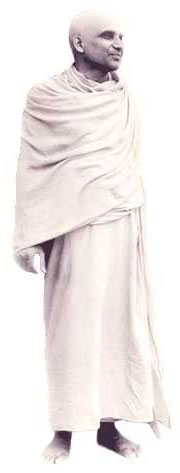
by Swami Krishnananda
The Divine Life Society - Sivananda Ashram, Rishikesh, India

1
1
chapter 5: Life as a yajna or Sacrifice (Continued)


This is a profound philosophy that is hidden behind performance of sacrifice, self-control, practice of yoga, the control of senses, the restraint of the mind and the stabilising of the intellect and the reason. We have to perform a double process - sometimes mentioned in the Bhagavadgita and also in Patanjali - of vairagya and abhyasa, a dual action of withdrawal and union. The performance of this dual function may be said to be a simultaneous action taking place, as recovering from illness is also the regaining of health and the going away of night is the coming in of day. There is no temporal successiveness in these processes; they happen to be a simultaneous occurrence. Thus, the vairagya that we speak of in yoga, the dissociation of consciousness from erroneous thinking and contact, is simultaneously a concentration of consciousness on that which lies above itself - the lower self concentrates itself on the higher.

Now I am coming to that point as to what the lower self is and what the higher Self is. The lower self is that state of consciousness which is conditioned by the urge in the direction of objects. The higher Self is that which is the condition of freedom, attained by even a single step taken by this involved consciousness in the direction of disentanglement with objects. Thus every ascent is a regaining of one's Self, and an asset on the side of strengthening of one's personality. Vairagya and abhyasa mean detachment and communion. Here, many people may get misguided due to the difficulty in understanding the true meaning of these terms, vairagya and abhyasa - renunciation, abrogation, detachment or non-attachment, going together with concentration, meditation, etc. We have to correctly understand what detachment means in order to know what communion is; and the whole of yoga is this much. If we commit an initial error, then we would be piling error over error in our subsequent actions or performances. Thus, we have to be vigilant at the very beginning.

Detachment is a success that we achieve in freeing our consciousness from involvement in any kind of objectivity - whether it is the form of intense liking or intense dislike, or finally even in the complacency that things really are outside. The initial step or stage in self-control would require us to free ourselves from emotional involvements, either in the form of intense like or intense dislike. But even if we are emotionally free and there is no great passion for things either positively or negatively, we may yet be unfit for the higher requirements in yoga. A mere good man need not necessarily be a fit person for yoga, because while goodness is a great thing indeed, a highly valued thing, it is itself not sufficient because yoga is super-ethical - it goes beyond the morality of mankind. It is not merely goodness, charitableness and a humanitarian feeling, though all these things are wonderful in themselves. So, when there is a freedom achieved to some extent from emotional involvements in the form of love and hatred, we might have attained a great thing indeed - it is a very important success - but yoga is something deeper and more difficult to grasp because, as we make a distinction between abnormal psychology and general psychology or rather, the psychoanalytical process and the study of ordinary psychological functions, we may have to make a distinction between two types of involvement of the mind in objectivity - the one emotional and the other perceptional.

Emotional involvements are studied in psychoanalysis, sometimes known as 'abnormal psychology'. By a deep understanding of our own self, we may be a healthy person psychically, and psychoanalytically we are perfectly hale and robust. But from the point of view of yoga, we may still be an abnormal person - because abnormality does not necessarily mean being a psychoanalytic patient. There can be a 'metaphysical error' as philosophers would put it, apart from a mere social, political or emotional mistake that we commit. Here it is that yoga goes beyond mere human ways of thinking, much less social and political ways. It is a cosmic way of envisaging everything, which will inject a sort of shock into us. We may begin to shudder even to think of the possibility of there being such a way of encounter with things, and this is the reason why sometimes we feel tremor in the body when we go deep into meditation - a shock which the pranas receive by the impact of the mind upon them, due to the intensity of our concentration on a supernormal level, which goes beyond ordinary human thinking.

So even if we are emotionally free and a good individual indeed, well adored and respected in humanity, we may not be prepared for yoga; because yoga is a preparation to embrace a reality, which is not necessarily a human world. This is also touched upon, pithily, in some of the aphorisms of Patanjali, which is not my subject at present - I am concerned with the Bhagavadgita. So, coming to the point of yajna, sacrifice, self-control, we seem to conclude that every sacrifice which is true to its spirit involves a metaphysical injection that we give to the psychological process of the mind, a spiritual adventure more than any other kind of human activity or a religious routine. We ascend into a supernormal degree of comprehension in our adventure of vairagya and abhyasa - withdrawal and union. From what do we withdraw ourself, and with what do we commune ourself? The withdrawal, as I mentioned, is not from the substance of the persons and things or the five elements, but from the way, the manner in which they are perceived by the senses, the mind and the intellect. Our opinion about things is what is important, rather than the things themselves. Our understanding is what is our concern, and not what we are understanding - the thing as such. The world, physically speaking, is not so much our concern in yoga as the way in which we are understanding it, and the manner in which we react to it.

Thus the process of vairagya, or detachment, is more a psychological activity rather than a physical performance. It is something that is happening inside in the mind. So we can detach ourselves from things even in the midst of things. Even in the thick of the bustle of people and the noises of the world, we can be detached, because the bustle and the haste, the movement and the noise are not the things that trouble us; the trouble arises from our reaction to them. The world is what it was, and perhaps it will be what it was - nobody can change it, and perhaps there is no need to change it; but there is necessity to change our understanding of it. It is possible to be free from concern with the external events in the world by a modification or an amendment of our outlook or perspective in life, even in the midst of thick activity. Here is the principle of karma yoga coming again: in the midst of intense activity one can be in a state of deep communion with the Ultimate Reality because of the fact that the mind is in the state of vairagya - completely withdrawn from erroneous associations with the events taking place with persons, with things, with activities. On the other hand, one may be in the top of Mount Everest, yet one may be involved in the world process. The thick of the jungle is not necessarily a safe place for the practice of yoga, because the absence of the presence of things, though it is an important thing indeed, is secondary considering our attitude to them. A deeply involved person may be involved even in the thickest forest - and an inwardly detached person may be detached even in the thick street of a large city. If we are honestly intent upon achieving true success in what is called 'yoga', we should not merely pat ourselves on the back and imagine that we are in a state of yoga or religious activity merely because it appears to be so, and people also say so. People may say anything - the saying of the people is no matter with us; it is another thing altogether that worries us and perhaps is our concern.

So, the yoga, the sacrifice - which is control of the senses, restraint of the mind, and the stabilising of the reasoning process, which is the yajna, the various types of yajna mentioned in the fourth chapter: prana, manas, indriya etc. mentioned there - all these suggest a single action on the part of our consciousness, namely an awakening into a higher Self. We may wonder why we should go on using the word 'Self' again and again, as if there is nothing else and no other word will connote what is our intention. The word 'Self' is a very important thing, because it suggests the true nature of things. We are not likely to understand the meaning of it because we are accustomed to identify self with our personality: 'yourself', ' myself', 'himself', 'herself', 'itself'. These grammatical words that we use suggest a wrong meaning of the term 'Self'. Self does not mean a person or a thing, though it is associated with a description of persons and things, yourself and others. The word 'Self' actually means the non-objective status occupied by everything in the world. Here is a sentence on which we have to bestow deep thought. A non-objective status which everyone enjoys and everything enjoys - this is called the Self. The Self is that which cannot be externalised, cannot be objectified, cannot become other than what it is; it cannot know itself as an 'other'. It is not an 'other' - it is just what it is. The real 'you' or the 'I' is what we call the 'Self'. This 'I' cannot become a 'you', a 'he', 'she', 'it' - it is just what it is. Inasmuch as this is the condition of everyone and everything, in a way we may say the whole universe is just the Self - Atmai eva sarva. The whole universe is a Self, only to be understood in its proper significance. If the whole universe is a Self and it cannot be objectified, because a Self is a non-objectified status, it would mean the universe is an intense self-consciousness; actually, what you call God is nothing but this. It is a highly enhanced condition of universal self-consciousness. This Self, which is principally and primarily a universal being, gets conditioned, by degrees, into lower forms of experience, until it descends into our personality-consciousness of the so-called physical 'I', the physical 'you', the physical 'it'. Thus it is self-control - I am coming to the point again - self-control means the restraining of the lower experience of the self by uniting it with the higher experience of its own Self. It is not a communion with somebody else. You are communing with your own self only in a larger, pervasive form than the condition in which you are at present. Your connectedness with things ascends in a series of larger pervasiveness until it reaches the apex of this pervasiveness in God-consciousness or Universal-realisation.

So, self-control begins with a little action of restraining the senses, and then becomes wider and wider, by degrees. These are the samapattis or samadhis mentioned in the sutras of Patanjali. These are the seven stages of knowledge. These are the communes attained with the levels of being, the realms of consciousness, the planes, etc. - these are the forms of Self. Gradually we get united with them until we become wider and wider, deeper and deeper, heavier and heavier, more and more comprises us, and nearer and nearer to our own self than we are now. Now we are far away from us. What a pity, we are far from our own selves. In the sense we are not this self we are thinking ourselves to be, as conditioned by this body; there is a larger kingdom in which we are residing, even now, from which we are apparently exiled into this grossness of the prison-house of this body consciousness. These are the fundamentals, and this is the background of all forms of self-control, which is the final meaning of any form of sacrifice - yajna.

  1
 
  Catalogue Search Site Map Contact
  Design by Savitr as a Love Offering