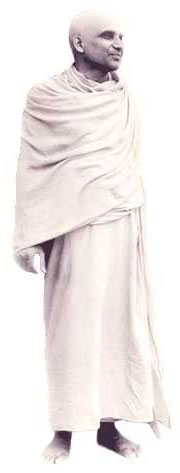
by Swami Krishnananda
Time is transcended here. Symbolically, the verse says: 'It is above the whole process of duration called time.' What you call year with all its days and nights which is the symbol of transciency, which is the indication of what you call time, above that this stands, which means to say it is transcendent to time, it is durationless eternity. It is not a movement in time, it is not a going to some place at some time. It is not some place because it is spaceless. It is not some time because it is timeless. Whatever be the stretch of your imagination, you cannot know what spacelessness is. You cannot also know what timelessness is, and therefore you cannot know what objectlessness is. The freedom of the mind from thinking in terms of space, time and objects is real freedom. But now we are caught into a compulsion of thinking only in terms of space, time and object. Who can be he, the best genius, imagining anything that is not in space, not in time and not an object! But freedom is that which is freedom from these three meshes. These are the Granthis, as they call it. These constitute the real bondage. So, It, so to say, puts down the whole process of time. 'This Reality is transcendent or above time' – yasmad arvak samvatsarah ahobhih parivartate.
Tad devᾱ jyotiṣᾱṁ jyotiḥ ᾱyur hopᾱsate'mṛtam: 'It is the Light of all lights.' The senses are a kind of light. When there is no eyesight, we say that there is no light. When the senses do not function, it looks as if there is no light in the world. You cannot hear; you cannot see; you cannot touch; you cannot taste. Well, it is then all a world of darkness. So when the senses function, it appears that there is light. But that is the Light of this light. You are able to see because of a Light which is different from the light of the eye, also in respect of the other senses, even the mind and the intellect. The gods which the mythologists speak of are nothing but the senses, the mind and the intellect, and they are the light for us. They are the guideposts; they are the indicators; they are our teachers; they are our masters. We act according to their injunctions. But this Reality, this Truth is beyond time and space and, therefore, beyond the senses. So, it is the 'Light of lights' – jyotisam jyotih. It is contemplated in a kind of meditation as eternal longevity. There are various meditations prescribed in the Upaniṣhads. These meditations are called Vidyās. All types of Vidyās are described in the Upaniṣhads, in the Chhāndogya and the Bṛhadāraṇyaka particularly. Here is one Vidyā, one method of meditation – contemplation on durationlessness, contemplation on timelessness. How is it possible? If it is at all possible, it is one type of meditation. Reality is not a process of time because it is not in space. It is not an object of the senses. It is therefore eternal longevity. Ayur means eternity and 'longevity of an endless character'. This is one kind of Upāsanā prescribed as 'meditation on the immortal essence which is timeless, durationlessness Being'.
'The five senses together with their objects are all located in this Reality.' They are not outside It, and It is not outside them. The Real that we are speaking of and are aspiring for is not only a transcendent presence. It is not even an immanent being. It is that which includes the external as well as the internal. 'The five senses which are our light, as well as their corresponding objects; earth, water, fire, air, ether, and everything that is constituted of these five elements; all these objects externally, and the senses which cognise or perceive the objects; the whole creation, as it were, is contained in an atom, you may say, in this vast expanse of Reality. This is the Self' – tam eva manya atmanam. So, the Self is not a little lamp that is shining in your own little physical heart. It is a universal conflagration and radiance which is not physical. This Ātman that the Upaniṣhad speaks of is not your Ātman, yourself or myself. It is not a grammatical self, as when we say, 'I, myself, have done it', or 'you, yourself, are responsible'. Such words of self are used in ordinary language. This is a very meagre apology for the real Self. The real Self is a container of even the vast creation. It is not merely an indicator as a light within the physical body of an individual. It is not a little candle flame shining in the darkness of your heart. It is universal resplendence, not merely light which illumines some other object like sunlight falling upon something else. It is not merely an ethereal light or a transparency. It is not merely an illumination which helps you to know something outside you. It is itself the light and the object, also. That is the Self. 'One who knows this becomes immortal.' He becomes Brahman, the Absolute – tam eva manya ᾱtmᾱnam, vidvᾱn brahmᾱ'mṛto'mṛtam.
It is the substance out of which everything that we are made of is made. It is the original of which we are duplicates, as it were. It is the archetype and we are merely the external symbols of it. Whatever we have within us – the Prāṇas, the senses, the mind, the intellect – are only feeble expressions of that Total Being which is the original, of which we are meagre parts. Sometimes it looks as if we are parts; sometimes it looks as it we are reflections. Either way, That is far superior. And, as a whole is not complete without a part, the part also cannot be peaceful without its relevance to the whole. So is this situation. Without us it is incomplete, and without it, we are incomplete. It is this Totality that we have to conceive in meditation as pranasya pranam. 'It is the Life of life, the Supreme Sense above all the senses, the Eye of the eyes, Light behind all the possible visions we can have through our eyes. It is the Ear of the ear (śrotrasya śrotram), and the Mind of the mind because it is the Cosmic Mind.' It is the Cosmic ocean of thought, of which we are like small drops. Our little thoughts, our little cognitions, our cogitations, our understandings and rationality are insignificant little invisible bubbles in the ocean of the radiance of Cosmic Being that is Cosmic Mind.
Manaso ye mano viduḥ, te nicikyur brahma purᾱṇam agryam: It is those who can comprehend this Truth in this capacity that can bring to light in their daily activity the vision of the Eternal, and live in this world as if they are living in the Eternal Itself. This very world, this world of Samsāra, becomes a radiance the moment you wake up from dream. When you wake from dream, you are not going to some other world. You are in the same spot, in the same place, and are the same person. Nothing has happened to you, but a sudden transfiguration has taken place in the way of thinking. That is awakening from dream. Likewise, in this very life, in this very existence, in this very world, at this very spot where you are sitting, this radiance of Eternity can be unravelled, provided the mind is transfigured by deep meditations as are prescribed in the Upaniṣhads.
It is explained now in more detail how the functions of the senses are inadequate for the purpose of the perception of Reality. The reason is that there is a compulsive activity on the part of the senses in the direction of diversity. A single mass of light is refracted and diversified when it is projected through a prism, but this diversity is mingled and comprehended together in the single mass of light. Originally, likewise, the single Reality is projected in a diversified manner when it is visualised through the senses. What the senses do is not to split Reality into pieces; they are not actually creating the diversity, but making it impossible for the mind to observe the Totality by abstraction of certain aspects of it from certain other aspects of it. Let us take the example of colours. There is no such thing as colour; it does not exist. What colour actually means is a particular abstraction of a character from the total capacity of sunlight to the exclusion of the other characters. When we perceive a green object, for instance, that particular object which appears to be green projects only that aspect of sunlight which we call green and excludes every other aspect. It cannot absorb into its body the whole capacity or force of sunlight. So it is with a particular sense-organ: the eye sees colours, but cannot hear sounds; the ears can hear sounds, but cannot see colours, and so on. The various senses perform independently, isolating characters, which are incapable of identification with their own functional capacities and making it appear as if their function is the only reality – e.g., a colourless world is incapable of perception. Thus, the total mass of Reality cannot really be apprehended at one stroke through the senses. Neither the eye can see, nor the ear can hear, nor the tactile sense can touch It. So, the Upaniṣhad says:
Manasaivᾱnudraṣṭavyam: 'It is only through the purified mind that It can be comprehended' – not through the senses. Here, the word 'mind' has to be understood in its proper connotation. It is not the lower mind or the psychological function which acts in total dependence upon the senses that is indicated here. There is a particular aspect of our mind which functions only in relation to senses. There is nothing that we can think which we have not seen or heard or sensed in some other manner. Even if we stretch our imaginations to the farthest extent, we will see that the mind can conceive only in terms of colours, sounds, solidity, three-dimensions, etc. So, this is the lower mind which is merely the functionary in terms of a synthesising activity of the various reports received through the senses. The diversity of sense-perception is put together in a blend in the mind, and then the mind is able to feel the harmony or unity among the various sensations. So there is perceptive synthesis in the mind. The mind does not give us any new qualitative knowledge. This part of the mind does not give, in spite of its synthesis, a knowledge which is qualitatively superior to the sensory knowledge. It synthesises, no doubt; it brings together in harmony all the diversities of sense function, no doubt; in that sense it appears to be a higher agent, but it is only a quantitative superiority that it exercises over the senses, not a qualitative superiority. Qualitatively, it is the same. There is however one aspect of our mind which is called the higher mind. It is rather difficult to distinguish it from the lower one. Sometimes we call it pure or higher reason, Para Vidyā, as the Bhagavadgītā also puts it. With this pure reason – Manasa – we may grasp It. It can be grasped only through the intellect, not that intellect which is dependent upon the senses, but the pure intellect which can ratiocinate on the basis of the unity of things rather than the diversity of things, knowing that this diversity does not exist at all – naiha nᾱnᾱsti kiṁ cana.
Manasaivᾱnudraṣṭavyam, naiha nᾱnᾱsti kiṁ cana: 'Inasmuch as the diversity is not there, really' – the senses are not the instruments, not the proper ones for the perception of Reality, as they always distort the vision. The idea of diversity is the cause of attachment to things. So you can now find out why we cling to things. It is because of our dependence upon the senses. Attraction and repulsion are both caused by dependence on sensory activity. Diversity is taken for the ultimate truth. The being that is projected through the senses as a target thereof, an object as we call it, is regarded as the sole reality as far as the senses are concerned, so that the particular sense which is after a particular object regards it as the sole reality. But it is not the sole reality, because it is vitally connected with other objects. The connection of one object with another is invisible to the eyes. It cannot be seen. There is a connection, for instance, between the various frequencies of radio waves; otherwise, they cannot travel through ether. Yet, they are different. They do not clash with one another. That they do not clash among one another means that there is a unity behind them. There is a basic uniformity of substratum upon which they travel which you call the ether. Likewise, there is a basic substratum underlying the diversity projected through the senses, but it is not seen. And because it is not seen, it is not believed, also. For the senses, the philosophy is 'seeing is believing'. When you cannot see a thing, it cannot be believed, it cannot be trusted. So, they follow this peculiar doctrine of believing only that which is seen or sensed, in some way or the other. Now, this is a very dangerous philosophy, inasmuch as it does not purport to present what is really there. The truth is that diversity is a false abstraction by the senses of certain characters of Reality to the exclusion of others. The Total Reality cannot be seen by the senses. That can be done only by a higher mind which can infer the existence of unity through diversity. How does the higher mind know that there is unity? Even the higher mind cannot actually cognise the presence of Reality, but it can infer its existence through a kind of logical induction and deduction. That is what we call philosophy. The entire system of metaphysics is a process of induction and deduction. You argue by certain premises that are given and you infer the existence of certain things, though they are not perceptible actually, physically, solidly. This is a very shrewd and tactful activity of the higher mind by which it concludes the existence of certain things which are ordinarily not capable of perception.