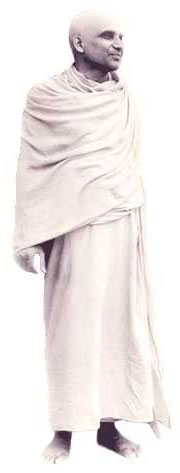
by Swami Krishnananda
Ceremonies: The ritualistic part of religion includes a set of functions and ceremonies which may be grouped under what are called Samskaras (purificatory rites), Kriyas (holy acts) and Vratas (vows). These ceremonies may be classified as those bearing relation to the (1) stages of life, (2) seasons of the year, and (3) special occasions. The periods of life of a person are those of a student (Brahmacharin), householder (Grihastha), hermit (Vanaprastha) and monk (Sannyasin). The prominent ceremonies relating to one's early life are those that are performed when (1) the child is born (Jatakarma), (2) the newly born child is named for the first time (Namakarana), (3) the child is given solid food for the first time (Annaprasana), (4) the child is initiated into the first step in education by being taught the letters of the alphabet (Vidyarambha), and (5) the grown-up child is performed the investiture of sacred thread and introduced into the holy Gayatri mantra of the Veda and thus led into the first stage in spiritual life (Upanayana). The life of the Brahmacharin commences at this stage, when he is admitted into the protection and care of a teacher (Guru) for study of the sacred lore and other branches of learning that may be regarded as necessary to him from the point of view of the class of society to which he belongs. When the student returns home after completion of his education, (6) the ceremony of returning (Samavartana) is performed. This particular ceremony has lost much of its meaning at the present time since the traditional form of student-period under the preceptor is nowadays not passed through, and the formality of this ceremony is undergone only at the time of marriage. Usually, on the completion of the period of studentship, one settles down at home after undergoing (7) the ceremony of marriage (Vivaha). Though the student is generally expected to go through the stage of the householder - and this is regarded as the most normal course to adopt in the majority of cases - scripture also makes a special provision that exceptional types of students who, due to a predominance of the spiritual urge in them, would not prefer to lead the life of the world (Pravritti) but wish to dedicate themselves to a life of pure spiritual pursuits (Nivritti), may pass directly from the stage of the student to that of a whole-timed spiritual seeker, either adhering to the vow of utter continence (Naishthika-Brahmacharya) and service to the preceptor till the end of his life, or as a monk (Sannyasin).
The householder, when he reaches a ripe old age, is expected to retire from active life and live as a recluse (Vanaprastha) leading a life of austerity, free from contact with his relatives. This is a period of preparation for the last stage of life which is the severing of oneself from all ties of worldly life (Sannyasa) and the devoting of all time to divine contemplation or acts which are conducive to this sublime aim. The goal of the life of a human being is the realisation of God, and all the stages through which one passes are preparatory processes for this final attainment. The whole of one's life is thus regarded as a continuous process of education for God-realisation, a journey which has its destination in the reaching of perfection.
The periods of life as a student and householder are full with special injunctions on the performance of ceremonies of different kinds. The prayer called Sandhyavandana to be performed thrice a day is obligatory on both the student and the householder. This is primarily a ritual of prayer to the Sun, in whom the brilliant face of God is visualised and worshipped. Daily worship of one's chosen deity is an additional duty of the householder. This worship is performed by him irrespective of whether he is at home or is on tour for any reason. This daily item of worship by the householder is, however, not so elaborate as the one performed in big temples, but is a shortened form of it, though retaining the essentials of the process.
A very important part of the daily functions of the householder consists of a set of fivefold duties called Pancha-Mahayajnas (five great sacrifices). The first of these is Brahma-Yajna or the sacrifice dedicated to the Vedas and their seers (Rishis) in the form of regular study (svadhyaya) of the holy scripture and the teaching of it to deserving students (adhyapana). The second is Deva-Yajna or the sacrifice offered to the celestials in the form of oblations poured into the sacred fire. The third is Pitri-Yajna or libations, etc. offered to the ancestors. The fourth is Manushya-Yajna or the feeding of uninvited guests (atithi). The fifth is Bhuta-Yajna or the feeding of animals, especially cows and birds. These five functions are imperatives on every householder and they are rightly regarded as great sacrifices (Maha-Yajnas).
In addition to these daily rites, the householder has also to perform certain monthly ceremonies such as offering libations to the ancestors on the new-moon day and the observance of the vow of Ekadasi or fast on the eleventh day of every lunar fortnight. The annual functions are those rites which are performed during such occasions as the birthdays of incarnations like Rama and Krishna, called Rama-Navami and Krishna-Jayanti respectively; the day sacred to Ganesa, called Ganesa-Chaturthi; the nine-day worship of Devi, called Navaratri-Puja; the festival of lights, called Dipavali, when special worship is offered to the goddess Lakshmi; the day when Skanda destroyed the opponent of the gods, called Skanda-Shashthi; the junctions of time when the sun moves towards the North, called Makara-Sankranti and Ratha-Saptami; the time when the new harvest in spring is reaped, called Vasanta-Panchami; the night most sacred to Siva, called Siva-Ratri; the day when Siva is said to have destroyed Cupid, called Kamadahana or Holi; and several other ceremonies like the annual offering of worship to the ancestors called the Mahalaya-Sraddha, and the days sacred to various incarnations of Vishnu, as also occasions when some one or other of the manifestations of holiness and piety in life is to be recognised and adored.
The ceremonies in the names of the dead have also great details, commencing with the rite of cremation and ending in the rites connected with the exaltation of the departed soul to the state of Divine Attainment. These rituals are all complicated in their nature and cannot be understood or performed by those who are not specially trained in their techniques.
The Purusharthas: Life has been always regarded in India as a process of progressive self-transcendence from the realm of matter (Annamaya-Jivatva) to the realisation of supreme spiritual bliss (Parama-Ananda). Human values and ends in life have been classified into the scheme of the fourfold pursuit (Purushartha) of existence, viz., the practice of righteousness and goodness (dharma), the effort towards earning of the necessary material values (Ardha), the fulfilment of permissible desires through honest means (kama) and the endeavour for the final salvation of the soul (moksha). This analysis is based on a broad understanding of the different levels of individuals in relation to the Universe.
The principle of dharma is summed up in the Mahabharata as the attitude of not meting out to others what one would not expect others to mete out to oneself. What is contrary to the welfare of one's own self should not be discharged or done in regard to others (Atmanah pratikulani paresham na samacharet). Another definition of dharma is that it is the conduct which conduces to prosperity here (abhyudaya) and spiritual blessedness hereafter (nihsreyasa). That charitable disposition by which one regards others in the world as ends in themselves and not mere means to one's satisfaction may be regarded as dharma. The practice of dharma in this sense is more than ritual or ceremony. Morality is superior to external rites. A moral act presupposes a moral condition of the mind within and the distinction between moral feeling and moral action is the same as that which obtains between character and conduct. The moral perspective is based on a general view of the world as consisting of a larger family than the one with which we are usually familiar. Our existence is wound up with great mysteries and is more complicated in structure than is apparent from a surface-view of things. The world-view which reaches its logical limits sees all beings as constituting a single unit of a universal cooperative life and the recognition of this fact in the smaller circle of individual and social life is dharma or righteousness. A violation of this principle is Adharma or unrighteousness. dharma sustains the organic structure of the cosmos, like the force of gravity which maintains the solidity of a body of matter. Adharma tends towards a rupture of the organism and brings about a condition of what may be called universal ill health. If dharma is health, Adharma is disease. dharma, thus, is eternal law and not the custom or religion of a country or people. All minor Dharmas which go by the names of goodness and religion receive the stamp of meaningfulness only when they are in consonance with this dharma of the Universe. The pursuit of material prosperity (artha), the fulfilment of one's desire (kama) and even attainment of salvation (moksha) are all based on dharma which is the rock-foundation of all practical life. None of these efforts can be successful if it is not rooted in the primary acceptance of the truth that the individual is co-extensive with the Universe.
The Ashramas: The grouping of life into the pursuit of the four Purusharthas is the basis of the ancient ethics of India. Every act of the human being pertains to one or the other of these aims. The ethical system in India is connected with the mode of life to be lived by one as a Brahmacharin, Grihastha, Vanaprastha or Sannyasin, which are the four orders (Ashramas) or stages of life. It is the injunction of the scripture that a person cannot remain in a stage which is none of these four strata of society.
Brahmacharya is the first stage of life, which is lived in the observance of the vow of perfect continence and celibacy under the guidance of a preceptor and dedicated especially to the study of the Vedas and other scriptures. The Kshatriya students may also have to be trained in the art of using weapons and administration in general. It is a life of probation and strict discipline. The Brahmacharin is an adherent to the principle of non-violence (ahimsa), truthfulness (satya), self-restraint (brahmacharya), non-covetousness (asteya), non-acceptance of gifts (aparigraha), purity and cleanliness (saucha), contentment (santosha), austerity (tapas), sacred study (svadhyaya) and service of the preceptor (guru-seva). These are the constituent factors in the life of a Brahmacharin. He shines with spiritual splendour (brahmavarchas), which he earns by way of self-control, and on account of this glowing nature of his personality he is termed a fire-lad (agni-manavaka).
While the stage of the Brahmacharin is particularly devoted to the accumulation of dharma, the life of the householder is for the preservation of dharma, the earning of artha and the fulfilment of kama. He puts into practice the knowledge gained during the period of Brahmacharya. artha and kama should be directed by dharma. This rule is a great scientific prescription for sublimation of desire, as different from its repression, regression or substitution. The householder is regarded as the hub of the wheel of life, round whom the welfare of the society revolves. His is a life of a balance of forces - social duty, personal desire and spiritual aspiration. His duties in the form of the Pancha-Mahayajnas have already been explained. This is the general rule for a householder belonging to the Brahmana class in society. The Kshatriya has the special duty of subscribing to the administration of the country by military service and the governmental system. The Vaisyas or the trading community, and the Sudras or the serving class, have their duties of providing for the economic harmony and needs of the country and the labour that is required for the sustenance of society. The classification of society into the four castes is not to be taken in the sense of a rigid mechanical isolation of groups by virtue of birth and heredity alone, as it has tended to be viewed in later times, but a logically developed cooperative system of living instituted for the preservation and prosperity of the whole society through division of labour based on the quality of persons and the proportion of the contribution that people can make for its solidarity in accordance with their aptitude, knowledge and capacity. Svabhava (one's inherent nature) determines Svadharma (one's duty as an individual in society).
The third stage of life is of the Vanaprastha and is devoted to the duty of disentangling oneself from the attractions of the world. artha and kama do not any more interest the mind which seeks only the final blossoming of dharma into the flower of moksha. The duties of life which meant a great value to the householder are relative to the phenomenal view of things and, while they are valid for sensory perceptions and mental cognition in the spatio-temporal realm, they do not reveal the Absolute which the soul hankers after and which alone can bring final satisfaction to it. The Vanaprastha girds up his loins to strive for this attainment through austerity (tapas) and inward worship (Manasika-Upasana). The Aranyakas and some portions of the Upanishads throw much light on the nature of the contemplations which the one dedicated to a life of spiritual discipline practises. While the Samhitas may be said to be relevant to the Brahmacharin and the Brahmanas to the Grihastha, the Aranyakas pertain to the life of the Vanaprastha. The consummation of this discipline is in Sannyasa or complete renunciation of worldly duty and desire, and living a life devoted to the highest meditations on the Absolute described in the Upanishads.
Though, originally, the order of Sannyasa as envisaged in the Manu-smriti and the Mahabharata constituted a purely spiritual condition into which the Vanaprastha entered, and it had no linkage with any social tradition, the order of the monk gradually developed into a system (sampradaya) by which the renunciates were related to one another, in different groups, by the allegiance they owed to their own particular orders, and thus formed a section of society devoted to a voluntary discharge of the obligation of the dissemination of knowledge, in addition to the individual duty of spiritual meditation. This compromise with social life arose not only due to the peculiar circumstances of a changing society in the passage of time, on account of which the minds of people in general may be said to have found a life of total isolation impracticable, but also due to the withdrawal of support from society in the way in which it used to be given in earlier days when the monks could sustain themselves on alms received without making their existence felt by people.