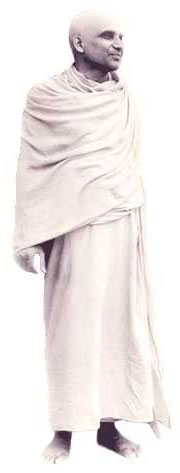
by Swami Krishnananda
In its true spirit, Sannyasa is a spiritual state, and not a social classification, in which established one learns the art of depending on the Supreme Being, by withdrawal of interest from the particular sources of support in the world. This condition is, however, not suddenly reached, and four stages even in the order of Sannyasa are recognised. In the first three stages, called the Kutichaka, Bahudaka and Hamsa, the Sannyasin lives in fixed residences, but in an increasing degree of freedom from the need for comfort, and the stages are distinguished by the increasing intensity of restrictions, in an ascending order, which the Sannyasin imposes on himself. The fourth stage is of the Paramahamsa, who is absolutely free from all the wants of a personal life and lives mostly a life of absolute self-dependence devoted to pure meditation. There are said to be two other stages, called the Turiyatita and Avadhuta, wherein fixed one does not pay attention to creature comforts and is satisfied with anything that comes to him of its own accord and remains mostly in a state of consciousness lifted above the body and its surroundings.
Sannyasa is also said to originate from four causes. A Vairagya-Sannyasin is one who enters the order being prompted by the latent impressions (Samskaras) which direct him to take such a step. A Jnana-Sannyasin is one who takes to the order due to his grasp of the import of the scriptures, after a deep study of them, and being convinced thereby of the existence of the spiritual ideal. A Jnana-Vairagya-Sannyasin is one who resorts to Sannyasa after deep learning and also having seen the normal enjoyments of life. A karma-Sannyasin is one who embraces the order having passed through the stages of the Brahmacharin, Grihastha and Vanaprastha, gradually. But he who takes to Sannyasa directly from the stage of Brahmacharya is called a Vairagya-Sannyasin. One who takes to it for acquiring spiritual knowledge is a Vividisha-Sannysin. One who enters it after having acquired this knowledge is a Vidvat-Sannyasin. One who embraces Sannyasa being compelled by impending death is an Atura-Sannyasin. One who takes to Sannyasa with a feeling that there is nothing except the Absolute is an Animitta-Sannyasin.
But Sannyasa is, in the end, as observed above, not one of the modes or orders of social life but a condition of consciousness in which it realises its spiritual absoluteness. Here ethics and spirituality coalesce in the attunement of the individual to the structure of the cosmos. Man becomes one with creation, being freed from the bondage of attachment, convention and anxiety. The soul fixes itself in the Infinite and knows nothing other than It. The duties of the Brahmacharin, Grihastha and Vanaprastha are progressive stages of self-sublimation and self-transcendence which reach their fulfilment in Sannyasa. The three basic cravings, called Eshanas in the Upanishads, which correspond to the psychological complexes in the form of desire for wealth, fame (with power) and sex, are overcome in the graduated educational process constituted by the stages of life.
The plan of life arranged into the four stages is a systematic endeavour for the conservation and transformation of the vital, intellectual, moral and spiritual aspects of human nature towards the purpose of the attainment of moksha or liberation in the Absolute. In this fourfold scheme, society is preserved and transfigured for an insight into the reality which underlies it. It is a remedy for the problems and ills of life born of the separation of society into selfish individualities. It is the process of integration not only of the individual but of the family, community, nation and the world at large, through the expression of the great preservative force tending to universal solidarity - dharma. The great hymn of the Veda, the Purusha-Sukta, makes the four aspects of the caste system limbs of the Supreme Being, thus teaching the organic structure of society knit into a single fabric with the threads of diversified personalities. Here is the philosophical background of the ethics of cooperation by which the Universe is maintained. The four Varnas (castes) and the four Ashramas (orders) are classifications based on the three properties (Gunas) of Prakriti - Sattva (equilibrium), Rajas (distraction) and Tamas (inertia) in their different permutations and combinations. The four Ashramas are the stages of the progressive overcoming of matter by spirit, externality by universality
The liberation of the individual in the Universal is the central aim of the ethics of India. The need for the soul's salvation arises from the recognition of the transitoriness of life. Not only this; life in the world is seen to be complicated by the operation of the law of action and reaction, called karma. Though karma, etymologically, means action, its extended meaning implies the force by which every action produces an effect, and, later on, it came to be identified with this effect itself. Profound thinkers discovered that the bondage of karma due to the reaction which every action produces is explained by the fact of the unitary structure of the cosmos of which individuals are inseparable parts, and karma arises only when this inseparable connection of the individual with the cosmos is forgotten and the individual indulges in actions with the false notion that it is an independent actor or doer, inviting thereby the nemesis of reaction. This nemesis is the bondage of the individual (Jiva), and it can break through this bondage only when the sense of individual doership is given up and a feeling of at-one-ment with the cosmos is developed.
An action is an effort towards the achievement of an objective. Man does not simply exist. He ever tends to become something else. The impulse for action is ingrained in the constitution of one's individuality. Action, thus, is an expression of the very make-up of the individual, and so one's entire life is action. Life and action have come to mean one and the same thing. The desire to possess and develop relations with external phenomena is the vital spring of all actions. The desiring individual is not always clear about the nature of the objects of desire. This confusion in the mind ends in the commission of unwise deeds in relation to the objects outside. Actions are one-sided in their motive, for the doer of the action has generally a constricted vision, which alone is allowed by any particular course of action. This course is taken without the knowledge of all the consequences of the action, which are wound up with the structure of the universe as a whole. Just as a good physician, while prescribing medicine for a disease, is cautious also of the reactions that the medicine may produce in addition to its healing effect on the disease in question, an expert handling of situations in life requires the engagement of oneself in actions with a knowledge of the different reactions they produce in addition to achieving the temporal desired objective, for usually one is oblivious of these side-effects when the mind is concentrated on the empirical result in view. The individual, when craving to fulfil a desire, has a rough idea of the nature of the effort required to fulfil the desire, but does not know that the source of action may disturb several other aspects of life and bring as a reaction suffering and grief in the end, though it may, for the time being, cause an enchantment into the belief that the desire is fulfilled. This is why the world is filled both with pleasure and pain - with foreseen effects of desires as well as their unforeseen results. An individual is born in a particular environment either because of a past wish cherished to live in such a condition or of an unknown consequence of desires. The miseries of the world are the forms of the reactions of deluded actions performed previously by its inhabitants. The world is a name given to the situation or manner in which individuals experience the fruits of their own desires and actions. The Universe is the shadow cast by the wishes of its contents and it is what these wishes are and what they sweep away from pure existence with the winds of the forces moving towards their fulfilment. We are asked to perform action without regard for fruits, because the fruits are not in our hands; they are determined by the general law of the Universe, which we, as individual sources of action, can neither understand nor follow. The accumulated and cumulative effects of actions done in all the past lives of individuals are packed into a concentrated residual of potentiality in their subtlest and innermost layer, constituting the causal world. The aggregate of all actions of the past, deposited thus in a latent form in each one's individual capacity, is called Sanchita-karma (accumulated action). This potential aggregate is carried by the Jiva in all its incarnations and it never gets destroyed until the attainment of moksha by the Jiva. The determining factor of every incarnation of the Jiva is the characteristic of that portion of Sanchita-karma, which is separated out as a specific allotment to be worked out in a given type of environment. This allotted portion of Sanchita-karma is called Prarabdha-karma (karma that has begun to produce effect). The Jiva, after being born in an incarnation by the force of Prarabdha-karma, performs further actions in its new life, called Agami-karma, the results of which are added on to the unspent portion of Sanchita-karma. This implies that the Sanchita cannot be exhausted and, consequently, the series of rebirths not ended until the Jiva ceases from adding new Karmas to the old Sanchita. The technique of performing actions without producing reactionary effects is called karma-Yoga. The doctrine of karma-Yoga, especially as propounded in the Bhagavadgita, is a commentary on the principle of universal action and reaction, and the way to one's redemption from its laws.
The resultant force of action has the future determined by it. Patanjali says, in his Yoga-Sutras, that the class of society into which one is born, the length of life which one is to live and the nature of the experiences through which one has to pass are all determined by the residual potency of past Karmas. These potencies become active in this life itself or in a life to come. A famous verse proclaims, 'One's life, action, wealth, education and death are all determined even when one is in the womb of the mother.' The doctrine of karma, therefore, is not a belief in fatalism as is often wrongly supposed, but the enunciation of a scientific law that operates inexorably and impartially everywhere in the Universe, like the principle of gravitation.
Samsara or the bondage of worldly existence is the outcome of karma. When a soul is born in samsara it comes invested with certain sheaths (kosas). The innermost and subtlest of the sheaths is the causal one, called also the bliss-sheath or Anandamaya-Kosa. The second is the intellectual sheath or Vijnanamaya-Kosa, the third mental sheath or Manomaya-Kosa, the fourth vital sheath or Pranamaya-Kosa and the fifth physical sheath or Annamaya-Kosa. Every preceding sheath is subtler than and pervades the succeeding one. The five sheaths are nothing but the Karmas of the soul manifest in a graded density of externalisation. In the various planes of the Universe, the soul may be born with one, two, three, four or five sheaths, as the case may be, in accordance with the intensity of the Karmas to be fructified in any particular plane. In death, the sheaths are withdrawn in their ascending order of subtlety, only to be manifest again into action after rebirth. The process of samsara continues till the salvation of the soul - moksha.
The ultimate freedom which the soul attains in moksha is the cessation of transmigratory life and the experience of the bliss of the Absolute. The Upanishads and the Bhagavadgita declare that the soul, having attained liberation, does not return to samsara. As rivers enter the ocean, losing their names and forms, souls enter the Absolute, having been freed from spatio-temporal limitations in the form of the five sheaths and worldly relations. By restraint of the mind from indulgence in the temptations of samsara, by devotion to the creator and by the knowledge that one's essential being is identical with the Universal Substance, the soul attains moksha. The condition wherein this experience of spiritual freedom arises in the consciousness even before the shuffling of the physical body, in certain cases, is called Jivanmukti or liberation-while-living and the attainment of this freedom after the leaving of the body is called Videhamukti or disembodied salvation.