Search
 
 
Home swamiji Ebooks Articles Multimedia Uploads Catalogue Sitemap Contact


Ebook
 
the Philosophy of the Panchadasi

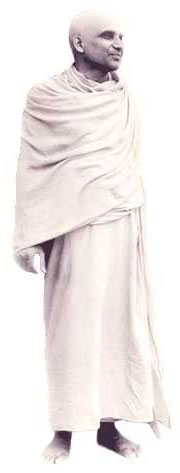
by Swami Krishnananda
The Divine Life Society - Sivananda Ashram, Rishikesh, India

1
1
Chapter 2: DISCRIMINATION OF THE ELEMENTS (Continued)
1
The Nature of Maya

As there is the existence of a consciousness behind the manifestation of all thought, there is a pure existence prior to the rise of names and forms as the universe. There is a power in Brahman which is not independent of it, but which can be inferred from the various effects that it produces, in the form of ether, etc., just as we infer the existence of heat in fire by means of its burning capacity. This power is not the same as Brahman, even as heat is not the same as fire. It is possible by certain methods to inhibit the burning power of fire without destroying the fire itself; yet we know that we cannot separate heat from fire at any time. This power of Brahman which is existence cannot therefore be considered to be different from it; else, it would become non-existence. Also, it is not existence in the sense of Brahman; hence essenceless. It is therefore indeterminable in character - Sad-asad-vilakshana - different from what is existence and non-existence. The Vedanta proclaims that in the beginning of things there was neither being nor non-being, but there was an indescribable something which looked like darkness. Even this darkness should have existence as its basis, because, without it, even darkness would not be possible. Even ignorance is something that we superimpose on what is existence. Thus there is no cause for any duality between Brahman and its power, even as there is no distinction between a man and his strength. This power is the same everywhere, but appears to be different due to the difference in the intensity of the manifesting media. We therefore, do not count Sakti or power by itself, nor do we consider it as the same as Brahman. Hence it is Maya which is Anirvachaniya, that which cannot be described in words, nor thought of by the mind, because language and thought are the expressions of Maya itself. It is impossible therefore to investigate its origin, its why and how, because all our faculties of understanding are only its effects. There is no understanding of the cause by the effect. The effect has first to rise to the state of the cause, so that it may know the latter. The mind has to rise to the condition of Brahman in intuition; only then will there be a knowing of what this power is. It is real to the ignorant, indescribable to the rational and non-existent to the Self-realised.

The Sakti of Brahman does not operate in the whole of Brahman. Else there would be no such thing as a possibility of freedom from Samsara. This Maya-Sakti works only in relation to the Jivas who are involved in it, and who regard Brahman as qualified by it in the form of Isvara. For the ordinary understanding, therefore, it is said that this Sakti does not pervade the whole of Brahman, but is only a part of it, as it were. The Vedas and the Smritis assert that creation is as if a mere quarter of the Creator, and three-fourths of Him stand above as the resplendent Immortal Being, transcending creation. It does not mean that Brahman can be divided into parts, for it is indivisible on account of its non-spatial and non-temporal character. What is meant is that this creating power of Brahman is relative to those in bondage, and it is those that are in bondage who seek for an explanation of the cause of this bondage by locating a cosmic causal principle which is unintelligible to them, and which they therefore, call Maya. The explanation of the world being impossible without a discovery of the cause behind it, and because such a cause has to be a cosmic principle in order that it may be able to provide a permanent explanation of the cause of the Jivas in bondage, this principle is associated with the creative Intelligence itself. Thus Maya is not eternal as Brahman is, because it has an end, though no beginning.

It is this Sakti that introduces change in the changeless, as a wall would appear to be variegated due to the paintings on it. (Verses 47-59)

On the Unsubstantiality of the Elements

The first of these changes is the manifestation of Akasa or ether. Akasa has the property of spatiality in addition to existence. We feel that space is, and it has also the quality of distinguishing things by a peculiar feature in it, which we call emptiness. Minus the quality of spatiality and reverberation of sound, space is nothing but existence, which is the same as Brahman. The Sakti which makes the manifestation of Akasa possible brings about also perversion in one’s understanding of the relation between existence and Akasa. Instead of feeling that Akasa is an after-effect and existence is prior, we are apt to think that Akasa is the primary substance and existence is a property associated with it, as when we say ‘Akasa exists’, thus mixing up the two, and making existence a predicate of the subject Akasa. This reversal of understanding is called Bhrama or delusion, which is carried further down into the various errors that we commit in the hundreds of precepts and concepts that we have or cling to in our life.

The perversion of understanding that causes the perception of space as a substance and existence as its property is again reversed into the right knowledge that Existence is the anterior substance and space is incapable of being without existence. It is therefore necessary to undertake a serious enquiry into the nature of space in order that there may not be deluded perception in regard to it. Existence and space differ from each other on account of their different names as well as by the disclosure of their real nature through reasoning. Existence and space are not synonymous terms. Hence they should indicate two different objects. Existence is commonly present even in air and other elements, but not spatiality. Thus the two have to be distinguished. Existence has a greater pervasive capacity than space and hence it should be the substance and space the property. Minus existence, space is nothing. We should not think that spatiality has a value of its own, because it is just another name for emptiness. Space is only an appearance like objects seen in dream, which are contradicted in waking. The differentiated world is contradicted in the experience of Virat, Hiranyagarbha and Ishvara. As genus and the individual, Jiva and its body, qualities and objects are distinguished in ordinary life, existence and space are to be differentiated. It is due to a lack of concentration of mind and certain doubts still lurking in it that one is not able to really feel that existence is the true substance. Concentration is to be practised for a protracted period by the usual methods of Yoga, and doubts have to be removed by right observation and proper reasoning. By meditation, observation and reasoning one comes to realise that existence is not space and space is not existence. To a Jnani or knower, the existence behind space alone is visible, and he does not see any such thing as spatiality or emptiness. In that condition he would rather be surprised to notice that people mistake space for existence. This analysis has to be carried on further in regard to the other elements also, viz., air, fire, water and earth.

The element of air also is to be analysed in the same manner as space. Air occupies a smaller part than space and inherits the quality of sound from space. The features of air are: (1) drying, (2) touch, (3) motion, and (4) velocity. It is felt to be existent; - this is the property of Brahman. It is unsubstantial when it is divested of existence; - this is the quality of Maya. It produces sound; - this is its inheritance from space. Though it is an effect, it is thus likely to be considered an independently real substance. As it has nothing which is not present in the preceding principles, we should regard air only as an appearance. It is existence alone that follows all the elements as a natural concomitant of everything, and space cannot be said to follow in that way. The quality of sound belonging to space follows the elements, but not spatiality. It should not be thought that air is absolutely real just because it is not directly connected with Maya which is the unmanifest qualifying adjunct of Ishvara. The answer is that unsubstantiality does not depend on being manifest or unmanifest, but on the capacity to vanish when divested of existence. Maya is not to be taken in the sense of any real substance that may create duality, but a name given to our inability to explain the relation of appearance to Reality. The existence-aspect of air is Brahman. The other aspects are unsubstantial. Similar is the case with fire, water and earth. Fire, water and earth have their own qualities, together with those of the preceding principles which are their causes in a sequence, but none of these have any intrinsic value when taken independently of existence. They are all a naught, minus existence. It is the earth-element on which existence is superimposed that the physical cosmos is situated. In the cosmos are located the fourteen worlds in which Jivas are placed differently under different circumstances according to their desires and actions. The Jivas are to recognise by this way of analysis that they are bound back to Brahman in their essential being; it is an erroneous feeling that they are widely separated in a spatial universe, an aberration of consciousness and not a fact. Nothing, really, separates one Jiva from another except the imaginary space. There is a real eternity and infinity here and now.

When the unsubstantiality of the elements and their modifications, of Maya and its forms, is properly driven home into one’s mind, the conviction that Brahman-existence is undivided reality gets firmly established. (Verses 60-98)

Liberation-in-Life

When existence is differentiated from the physical cosmos that appears as the object of Jivas, it may still appear to them, but cannot affect the indivisible nature of existence, as the water of a mirage cannot wet the desert. Once knowledge arises to the effect that the background of all the elements and their formations, and even of Maya, is the indivisible Absolute, Brahman, it cannot again be shaken by any other experience. Nevertheless, the liberated souls may, through the medium of the body, continue to perform actions as before on account of the presence of certain Sattvika samskaras, but may not get bound, as the ignorance is destroyed. The divergent truths that are indicated in the different schools of philosophy such as the Nyaya, Vaiseshika, Sankhya, and so on, are to be regarded as having a partial validity from their own standpoints, though none of them is absolutely complete. When there is a rise of divine wisdom, there is also the realisation that everything has a relative value in its own place, and nothing is absolutely wrong, though not absolutely right. When a person gets rooted in the feeling of the oneness of things, he becomes a Jivanmukta, liberated while living. If one is able to establish oneself in this knowledge even at the end of time, one shall attain to the Bliss of Brahman, says the Bhagavadgita. Here, the phrase, ‘at the end of time’ means either the end of ignorance or the end of the body, because it is possible to have divine knowledge even if the body is to linger on due to some past Karmas. It does not matter what the physical condition is of the liberated person at the time of his shuffling of the body. He may be physically healthy or otherwise, may even be temporarily in a state of unconsciousness, but the knowledge which has been once attained will revive itself again when he is placed under different circumstances and regains consciousness, even as what is learnt the previous day is remembered the next day, though it is forgotten in the middle during sleep. The knowledge attained through meditation on the truths of the Vedanta is indestructible. Thus, by a careful analysis of the nature of true existence behind the five elements, and remaining in that state of knowledge at least at the last moment of one’s life, one reaches the state of Divine Bliss. (Verses 99-109)

  1
 
  Catalogue Search Site Map Contact
  Design by Savitr as a Love Offering