|
The Reality that is
established in philosophy is to be experienced in
the state of deep meditation. Here consciousness
and being become one. There is no way of entering
into communion with it except by being it. There
is no such thing as subject-object relationship in
regard to the consciousness of what is universal.
Either one knows it fully in non-dualistic communion
or does not know it at all. The senses, the understanding
and the reason are powerless instruments in one’s
attempt at perfectly comprehending its nature or realising it in experience.
In the realisation of the Supreme Being the mind of the individual is completely
transcended, together with all its dualistic categories. The mind does not
partake of the characteristics of Reality. It is not conscious and also not
universal in nature. The mind is a feeble objective insentient evolute acting
as the individual’s instrument in the perception of the external world,
which is physical in nature. By its very nature it knows only what is outside
it and cannot know what is above it or what is presupposed by it. Hence nothing
that is known to the human being in this empirical world can be of any use
in the realm of the trans-empirical Consciousness. The objects of the senses
get fused, as it were, in the constitutive essence of the Absolute. Space,
time and causation, matter, energy and objects vanish in the menstruum of
its stupendous existence. The Absolute of philosophy is not an object of
consciousness, but is what consciousness itself is in its real and essential
nature. Thus philosophy is the pathway to the realisation of the Absolute
Consciousness through the ladder of the different stages of the relative
consciousness.
Rational Presentation of Experience
Philosophy is not to be confused with intuition,
with mystic or religious experience, though it is a very powerful aid in
achieving this end. Philosophy in India is based on the revelations of the
sages and provides the necessary strength to the future generation of mankind
for realising this goal. In mystic or religious experience the intellect
and the reason are completely transcended, while philosophy is all intellect
and reason, though it is grounded ultimately in deep religious experience.
While the intuitional truths are rationally explained by philosophy, it does
not pretend to prove the nature of these truths through intellectual or scientific
categories. Philosophy has a purely negative value—of offering an exhaustive
criticism of sense-experience and logical thought and indirectly arriving
at the concept of Reality by demonstrating the limitations and inadequacies
of the former. All philosophy really springs from an inward dissatisfaction
with immediate empirical experience consequent upon the perception of the
inadequacies inherent in its very nature. This leads to a critical examination
of the constituents of empirical experience and a profound study of its hidden
implications. This is philosophy. A justification of the super-mental and
non-temporal Absolute is attempted through a searching analysis and understanding
of sense-experience and rational judgment, while the defects and implications
of the latter are fully disclosed. Truly speaking, philosophy can neither
be purely subjective in its approach, nor purely objective in the sense of
an alienation from the perceiving subject. It will be seen in the course
of the study of the principles constituting the universe that what is implied
within in experience is also implied outside in the contents of experience
and in the objects and the conditions that are necessary for bringing about
this experience. Thus philosophy becomes a universal approach to Truth made
by the subject and the object simultaneously with equal authority, meaning
and strength, making no difference in value between themselves. The movement
of thought is from the physical to the biological, from the biological to
the logical, and from the logical to the spiritual. Philosophy should, therefore,
constitute a comprehensive analysis and study of the whole of experience.
It has no partialities, no prejudices, no preconceptions, no likes, no dislikes.
It marches bold like a heroic warrior with truth, justice and wisdom as its
supreme aims. It makes ample use of all the powers that the human individual
is endowed with and reaches the farthest limit of these powers, where what
it observes and studies is not that which is immediately experienced, but
what is inferred from and logically implied in the facts it envisages directly
in that borderland between understanding and reason. Man possesses nothing
superior to reason, and so philosophy cannot go beyond it. In a way philosophy
is a rational criticism of reason itself, when we take reason to mean not
merely an isolated abstract power of intelligence, but also all the objective
factors and conditions that are necessary to make it what it is. When reason
rationally knows its own limitations and also the reason why it is limited,
it knows Reality in a negative way. This negative knowledge becomes the starting
point of the effort towards its positive realisation in meditation and communion.
Philosophy has no quarrel with science;
it concedes that science is necessary and useful in reinforcing its own conclusions,
but it strictly warns science that it is limited to physical phenomena. We
study the physical, chemical and biological laws in science, the logical
and metaphysical principles in philosophy and the moral and the spiritual
verities in religion and the higher mysticism. The senses, reason and intuition
are our ways of knowledge in the progressive unfoldment of our nature. Science,
philosophy and mysticism are true and useful in their own places and together
constitute the highroad to a knowledge of life as a whole. Intuition, however,
has the special advantage of being able to unfold all that the senses and
reason can, and, in addition, also that which these cannot hope to know with
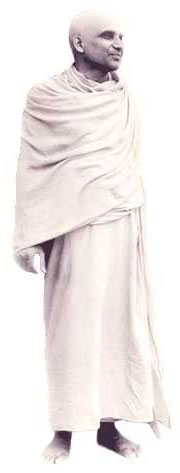
all their power. The philosophy of Swami Sivananda is not any partial approach
to Truth; it is that grand integral method which combines in itself the principles
and laws discovered and established by science, metaphysics and the higher
religion and which embraces in its vast bosom whatever is true, good or beautiful
in the universe. What he says of the Vedanta is true of all genuine philosophy
aiming at the salvation of the human soul: “Vedanta is that bold philosophy
which teaches the unity of life or the oneness of consciousness.” “It
is that sublime philosophy which elevates the mind at once to the magnificent
heights of Brahman-hood, divine splendour and glory, which makes man absolutely
fearless, which destroys all barriers that separate man from man and which
brings concord, unruffled peace and harmony to suffering humanity.” “It
is the only philosophy that, when properly understood and practised, can
put a definite stop to world wars and all dissensions, splits and skirmishes
that exist in different nations and communities.” “Vedanta is
a magnetic healing balm for the wounded and the afflicted in the dreadful
battlefield of this dire mundane existence. Vedanta is the divine collyrium
which removes the cataract of ignorance and gives a new inner eye of intuition
or wisdom.” “It gives real inner spiritual strength. It inspires,
renovates, vivifies, invigorates and puts a stop to the never-ending wheel
of birth and death and confers immortality, infinite knowledge and bliss” (Vedanta
in Daily Life, pp.3-4). To Plato, philosophy is the dear delight, and
the philosopher is the spectator of all time and all existence, and is one
who sets his affections on that which really exists. For Spinoza, it is the
perception of things sub specie eternitatis.
Classification of Themes
Philosophy conceived as metaphysics deals
with an extensive reasoned discussion of the natures and the relations of
God, world and the individual soul. The latter two are either identical in
essence with God, or are attributes or parts of God, or are different from
God. The ultimate Reality is either God, or the world of perception alone,
or only the individual mind. God either exists or not, and is necessary or
unnecessary for an explanation of experience. The world is either material
or mental in nature; and consciousness is independent of or is dependent
on matter. The world is either pluralistic or a single whole; and is real,
ideal or unreal, empirical, pragmatic or rational. The individual is either
free or bound. Questions of this nature are usually discussed under metaphysics.
It also delineates the process of cosmogony and cosmology, the concepts of
space, time and causation, creation, evolution and involution, as well as
the presuppositions of eschatology or the discourse on the nature of life
after death. The philosophical basis of modern physics and biology also can
be comprised under metaphysics. Under epistemology the various theories
and processes of the acquisition of right knowledge, as well as the nature
and possibility of wrong knowledge, are discussed in detail. Sensation, perception,
inference, comparison, verbal testimony, presumption, non-apprehension and
non-relational intuition are the various phases of the ways of right knowledge.
Intuition, however, is not to be classed as one of the ways of knowing, for
it is the one supreme way of right knowledge, transcending all other empirical
means. Knowledge is said to be erroneous when one thing is mistaken for another,
whatever the reason be for this error. The several causes of error in perception
are also discussed under epistemology. Under aesthetics the significance
and the nature of beauty are discussed in philosophy. Beauty is either subjective
or objective or relative to the subject and the object. It, again, is either
real, ideal or unreal. As ethics philosophy engages itself in the
ascertainment of the nature of right and wrong, good and bad. It deals with
the nature of moral standards and moral judgments, the rights and the duties
of the individual, the society and the state, the national and international
good, the nature and function of conscience, and the like. Ethics is either
naturalistic, hedonistic or metaphysical. Under psychology the constitution,
function and behaviour of the mind is discussed in philosophy. Psychology,
apart from its dealing with general topics, such as the springs of action,
thought, intelligence, emotion, will, feeling, the relation of mind and body,
the nature of internal conflict, the mechanism of sense-knowledge, etc.,
may be distinguished as individual, social, educational, religious, analytic
and group psychology. There has been a tendency in recent times to segregate
psychology, as a purely objective science, from philosophical studies that
are not confined merely to the region of observation. Under axiology philosophy
establishes the nature of values in the different stages and views of life,
such as physical values, aesthetic values, moral values, religious values,
etc. Mysticism is in a way the most magnificent part of philosophical
studies, though certain rationalist philosophers, in their enthusiasm to
save themselves from falling into irrationalism of any kind, commit the error
of not knowing that true mysticism deals with truths that range beyond and
determine all rational processes of knowledge. Mysticism mostly concerns
itself with the inner relation of the individual to the Eternal Being and
with the various techniques of the ascent of the soul in the fulfilment of
its religious and spiritual aspirations, with the picturesque experiences
it undergoes and the dangers and the difficulties it has to encounter on
the way, with the psychology of the phenomenon of religious consciousness
and the philosophical foundations and implications of the inner path of the
Spirit, and also the meditations which the seeker of Truth has to practise
for the ultimate attainment. The Vedanta and the Yoga are perfected and finished
systems which comprise all these branches of study, and so deserve in every
sense of the term the designation of philosophy. Swami Sivananda has recorded
in his works his unequivocal conclusions on these wondrous themes, which
point in the end to the self-realisation of consciousness in the Absolute.
Though philosophy, in the system of Swami
Sivananda, is mostly understood in the sense of metaphysics, ethics and mysticism,
its other phases also receive in his writings due consideration, and are
placed in a respectable position as honourable scions of the majestic metaphysics
of his Vedanta. For him the basis of all knowledge is the existence of the
Absolute Self, and perception and the other ways of knowing are meaningful
on account of their being illumined by the light of this Self. Epistemological
problems are, therefore, in the end, problems of the nature and the manner
of the manifestation of the Absolute through the psycho-physical organism.
Beauty is the vision of the Absolute through the senses and the understanding.
The main material of beauty is symmetry, rhythm, harmony, equilibrium, unity,
manifest in consciousness. The perception of these characteristics is the
neutralisation of want and one-sidedness in consciousness, the fulfilment
of personality, the completion of being, and hence a manifestation of the
Absolute, in some degree, in one’s consciousness. The aesthetic consciousness
is thus the result of a partial expression of the universal in conscious
experience. The good is that which, directly or indirectly, leads the individual
to the experience of the Absolute, which is the ultimate good. Primary virtues
are those which are directly concerned with the conscious movement of the
finite to the Infinite, and the secondary ones are those indirectly responsible
for this attainment. The way of the good is the direction of the right. Ethics
is the science of the inner conduct that is good and right. The psychological
principles, to Swami Sivananda, are but certain of the several stages and
functional points of the appearance of the Absolute in the evolutionary process
of the external subtle universe existing behind the gross mass of the five
elements. Psychology is thus one of the most interesting and essential of
sciences, inasmuch as it investigates and studies the nature of the operations
and behaviour of the mind, which is the medium, in the realm of relativity,
of the perception of the Absolute. All values, intrinsic or extrinsic, are
rooted in the judgment of the supreme value of the realisation of the Absolute,
which is the eternal home of all other values and in which all other values
find their fulfilment. Axiology has to be referred back to metaphysical studies.
Mysticism, for Swami Sivananda, is the path of the practical knowledge and
experience of the great truths of metaphysics, the disclosure of the realities
of God, the world and the individual, the recognition, in direct intuition,
of their true relations, the grand rising of the soul from the slumber of
ignorance and its realisation of the beatitude of the Absolute. The several
techniques of Yoga and Jnana are comprehended in mysticism of the right type,
and it sums up what is usually known as the spiritual path or the way to
the Life Divine. Philosophy is a term generally applied to a study of all
these aspects of life’s meaning, and so it forms the most attractive
pursuit of the human being in general.
|