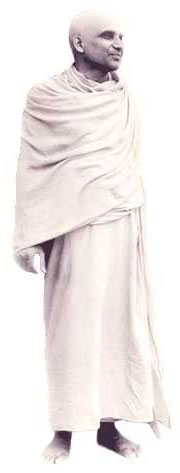
by Swami Krishnananda
The object of a Vritti or a mental mode may either be an external object or an internal content, something outside the mode or the mode itself. Perception is the unification of the Vishayachaitanya with the Pramatrichaitanya through the operation of the Vritti. In perception the functioning of the sense-organs is not absolutely necessary, it is not an unavoidable condition of perception. Whether there is the operation of the senses or not, when there is an identity brought about between the consciousness particularised by the object and that modified by the Vritti, there is admitted to be perception. Right perception is to be defined as the union of the Pramanachaitanya and the Vishayachaitanya in the case of a Vishaya or object which is fit to be known, or capable of being known, and wherein there is the spatial coexistence of the Pramanachaitanya and the Vishayachaitanya, together with the contemporaneity of the two. In internal perception, like that of pleasure and pain, for example, the limiting conditions of the object, i.e. pleasure or pain, and the mental mode experiencing it, get identified at one and the same place and the same time. The identity of the object and the subject in internal perception is, as far as this fact is concerned, the same as in the case of external perception. The substratum of the subject and the object in internal perception is one and the same, viz. the internal organs as modes in the universal consciousness. In the external perception of an object the mental mode flows out through the channels of the senses to the object outside, pervades it by Vritti-vyapti and causes the illumination of the object by lifting its Tula-avidya, by means of the Sakshichaitanya or the Witness-consciousness that is illuminating the mental mode, thus bringing about Phala-vyapti or conscious perception of the object. In internal perception the mental mode does not move towards any object, for here the object is the mode itself directly illumined by the Sakshichaitanya. Internal perception is caused by Vrittis or mental modes corresponding to the modes of these percepts. But the Vrittis themselves are self-luminous and do not require another Vritti to illumine or cognise them. The assumption or introduction of some other Vritti for the cognition of the internal modes may lead to an infinite regress of Vrittis behind Vrittis. The Vrittis should be admitted to be self-luminous, capable of being cognised directly by the Witness-consciousness defined by the Antahkarana. Pleasure and pain are known through the Vrittis, but the latter are known immediately by the Witness-consciousness through the mind. This immediate cognition of the Vrittis by the Witness is not without its being associated with the Antahkarana and its limitations. The cognition of the Vrittis by the Witness is immediate in the sense that here the senses are not needed as media of knowledge. Though there is no second Vritti by which the Witness may know the object of internal cognition, it is associated with the Vritti by which the objects are known. The Vritti of pleasure or pain, for instance, is an object as well as a subject. It perceives itself non-mediately. Empirical perception can occur only of individualised objects, and so such perception is not possible either of the universal Atman or of mere negation or non-existence. “In the case of internal cognition, i.e. awareness of the mental modifications, Vritti-vyapti takes the form of remembrance or inference, because here no perception of an external object is necessary. In Brahma-jnana, however, there is no Phala-vyapti, because Brahman does not require another light to illumine itself” (Questions And Answers: p. 87).
An empirical perception is to be regarded as true when it stands the test of correspondence, coherence and practical efficiency, and is capable of satisfying the principle of non-contradiction. According to the correspondence theory, truth is a relation between an idea and its objective content. The idea of an object should correspond or agree with the content of perception. Realists hold that truth is independent of human cognition and remains unaffected by it. Reality does not depend upon our perception of it. Truth is here fidelity to reality, agreement with fact. According to the coherence theory of truth, truth is the relation of consistency or internal coherence between all parts of our experience. Truth depends upon the harmonious constitution of consistency of the different constituents of a proposition or judgment with the parts constituting truth. Logical coherence is the criterion of truth, and not mere agreement of idea with fact. The pragmatic theory of truth leans on practical efficiency, workability in experience, what leads to satisfactory consequences, what is useful in practice and life. Truth is valid. What works as truth or satisfies us as truth is to be considered as truth for all human purposes. It is true that there cannot be correct perception unless there is a real object outside, to which our knowledge may correspond. But correspondence is not the only criterion of truth, for there can be correspondence even in the case of partial truths or even errors. Correspondence has to be testified by the principle of coherence or the organic nature of knowledge, which satisfies consistently the perceptions of the different sense-organs and agrees with similar perceptions of the object by others. Truth also has the character of practical efficiency or workability in actual life. Though the workable need not necessarily be true, the true is always workable. Though utility is not the test of truth, truth has always the utility that is unique to its nature. All these tests, however, are based on the fact of the self-evident and perfectly valid nature of one’s self-consciousness. Consciousness is its own test and proof, and it exists as the basis of all proofs. The reality of the silver seen in nacre is nacre, and the reality of nacre is the universal consciousness. The reality of dream perception is rooted in the waking consciousness of the individual, and the reality of this latter is the Turiya or the Atman. The truth of an object should correspond with its essential nature. But no human idea or concept can correspond to the reality of the Atman or Brahman, for here no relational category can be introduced into knowledge. Empirical tests of truth cannot be applied to it, for all these tests are based on the notion of duality, while the Atman is non-dual, is its own proof and validity, and the test of its experience is its self-evident nature. This is the only experience which is ultimately non-contradicted and so the ultimate truth. In this highest being of consciousness the knower and the known are one, and in it all logical tests lose their significance.
For all purposes of life, an object of correct perception by the Pramatrichaitanya is real and has an existence of its own leading to successful activity, corresponding to empirical facts and cohering with the perceptions of others in regard to it. But it has to be added here that what satisfies these tests of truth need not be absolutely real. The world of experience, to the Vedanta, is, in the last resort, subject to sublation in the knowledge of the Atman, to which the objects of the world cannot correspond, and in which it loses all practical efficiency, and also proves to be incoherent with the structure of the hidden and real nature of the universe. Metaphysically, and apart from what is revealed in temporal perception, all things exist in a system in which they are interrelated and mutually determined as elements ultimately contained in a supersensible completeness. Everything in this universal system implies and is implied by everything else, so that in essence everything is everywhere to be found. Consequently, it would mean that to know anything in the world perfectly one would have to know the whole world at one stroke, and intuit pure being in non-temporal immediacy, for the search of the ultimate reality of any object leads one to other objects, the nature and mode of whose existence determines it, so that the search can end only on reaching and realising indivisible being. Empirical judgments have only a pragmatic value, are relatively valid and sufficient for all practical purposes in one’s day-to-day life. But such judgments are not ultimately valid, for all sense-knowledge has to be classed under appearances, since it proceeds from the reflection of the Atman in the Antahkarana and catches only aspects of reality in the forms of discrete objects in space and time. Everything in the world points beyond itself to a boundless existence, and this fact is demonstrated in the constant change that things undergo, and their tendency to overcome barriers and obstructions at every step. Everything embraces all other things, for everything is a mirror reflecting the whole universe. Judgments which presuppose the isolated existences of things cannot be ultimately true, for all things exist in and for the whole. The knowledge of the true essence of things is given not in relational perception of externalised conditions or objects, but in the intuitional revelation of the Absolute.
Empirical knowledge, according to Swami Sivananda, is the result of the action of the Antahkarana-Vritti illuminated by consciousness. This consciousness is finally to be discovered only in the Atman, and nowhere else. Ordinarily speaking, empirical knowledge is a relational product caused by the rise of consciousness in the subject due to the reception of external stimuli in the form of sensations. The sensations are tremendously influenced by the subtle impressions or Samskaras embedded in the mind of the knower, and hence in perceptive knowledge there is an element of the force of the personal constitution of the subject playing an important part and determining the nature of the experience that is given in perception. But the actual material content of sensations is not the product of the internal Samskaras or the cognitive consciousness, but bears relation to objects existing externally. Whether or not the objects, on ultimate analysis, prove to be indeterminable appearances which cannot be related in any way to an extra-mental reality, it is admitted by the very nature of the constitution of the subject and the nature of this experience that there ought to be an extra-mental basis for the appearance of objects. The theory of perception, then, leads to an epistemological realism, while at the same time implying a metaphysical idealism positing the existence of an absolute consciousness behind both the object and the subject. While it is accepted that the subject is in no way the cause of the existence of the object, and that the object is independent of the empirical existence of the subject,—for the universe of perception reveals itself as an organic completeness containing within itself the subject and the object as elements partaking of the same level of reality,—it is held that there is a higher reality of a spiritual nature, which comprehends and transcends the relativity of the subject and the object. The Pramatrichaitanya is not the transcendent Atman but the Jiva-chaitanya functioning in the world and subject to the laws of the world in which it works. It has therefore, no power over the existence of the object of perception, for the existence of this latter is not in any way inferior to that of the subject in the degree of its reality. It may be said neither that the object solely determines the character of perception nor that the subject fully determines the nature of the object, but there is a mutual interaction of the two sides in bringing about relational knowledge. Perceptual knowledge is individualistic, relational and so a process or an act, but knowledge in its essence, as the Atman, is non-relational and identical with simple being (Vide, Commentary on the Brahmasutras: Volume I, pp. 384-390).
Knowledge has to be considered to be an organic whole of the material of sensations and the perceiving consciousness. There are cases where the passions, ambitions and griefs of the subject are transferred to the object of perception, and the object is perceived to be beautiful, good or ugly or otherwise, in accordance with the nature of the mental condition of the perceiver. The perception of such objects produces an experience which is valid only to that private individual. Perception of this nature comes, in fact, under illusions and is not right knowledge. In right perception the object reveals to the subject a nature which is also in agreement with the perceptions of it by others. Anyway, there is a reciprocal determination of the knower and the known in perception. All objects appear to be real at the time of their being known, but prove to be indeterminable on a logical analysis of their nature, and reveal their unreal character when contradicted by a higher and more inclusive experience. The object and the subject are logically distinguishable but not really separable. They have an empirical duality, but a real unity. As long as we take the individual subject to be the real knower, we have to admit that objects are not determined by sensations but that sensations are referred to externally existing objects. But the identity of the subject and the object of knowledge is revealed on the recognition of the true subject which is the highest Atman in us (Vide, Secret of Self-realisation: Jnana-Yoga).
On ultimate analysis it is discovered that there is nothing either in the object or in the subject except mere name and form plus the universal consciousness on which the name and form appear. Even space, time, substantiality, extension, resistance and causation are but the schema of the universal knowing subject fastened on to a network of objectivity. On receiving sensations one must, truly speaking, not refer them to anything outside in space, but to the essential nature of the consciousness which is the real subject. If this is done, there will be an experience of the instantaneous illumination of the Atman as shining within and without, as subject as well as object. The rationalistic and the empiricistic attitudes to perception are reconciled in the acceptance of the Atman as the fundamental reality. It is the Atman that masquerades as the seer and the seen within space-time, and exists as the true substance behind the forms taken by the seer and the seen.
An understanding of the characteristics of our judgments of truth and error forms an integral part of philosophical knowledge. This understanding is necessary for the discovery of the deeper implications of experience. Knowledge, ordinarily, presupposes a subject of knowledge and an object corresponding to it. The nature of this knowledge is dependent upon the mind and the cognitive organs of the subject, as well as upon the conditions in which the object is situated in relation to the subject. The knowledge of colour through eyes which are affected with jaundice may be incorrect, since there is every possibility of its being the perception of an apparently objective yellow colour, though what is really objective may be some other colour. In the same manner, a distant object may be mistaken for something different from what it is, though the organs of perception may be in a healthy condition, and this error may be caused by a peculiar relation obtaining between the percipient and the position of the object. Our perceptions of things greatly influence what we infer and decide, which means that our life is judged by us in accordance with the modes of our perception and the knowledge based on them. As every inference is based on previous perception, erroneous perception will nullify the value of the inferences built upon it.
Two kinds of erroneous perception may be distinguished from each other: the mistaken identification of an object really experienced at a given moment with another object which is at the same time in contact with the sense-organ, and the erroneous attribution of an object of memory to another object which is in contact with the sense-organ. The experience of bitter molasses on account of the affection of the tongue by bile and the perception of an yellow object on account of the yellowness of the bile affecting the eyes are instances of the first kind of error in perception. Molasses is sweet, and this is what is really experienced by the tongue, but the bitterness of the bile so influences the gustatory sense that the sweetness of the molasses is seriously affected by it. Similarly, the yellow colour of the bile affecting the eyes becomes a screen through which an external object is perceived, so that the object itself appears to partake of the character of yellowness. Here two things are known at one and the same time, both of which are real experiences, but due to the one being superimposed on the other, there is erroneous perception. In the case of the perception of silver in nacre or the perception of beauty in the object of one’s love, there is erroneous perception of a different kind, for here something which is not really existent in the object, becomes the content of one’s consciousness. In the first instance of error, that which is superimposed and that on which it is superimposed are both directly perceived objects. But in the perception of silver in nacre, the error is caused by the sense-organs working in association with a memory of the silver seen in the past and revived in the perception of glitter which is common both to nacre and silver. Both forms of error noted above, i.e. those in which only real objects are involved and those in which a real object and an object of memory are involved, are sensory in character, for these are erroneous perceptions through the sense-organs.