|
The
Glory of Contentment
When one is pure in mind, pure in speech
and pure in body, there is a contentment arising from oneself. There is
Santosha. It is very essential that one should be happy under any circumstance.
This is very important. If a person is weighed down heavily with some grief or
sorrow, and he becomes melancholy and moody, and gets into a state of weeping
and crying, and is not able to sleep because of the sorrow that is eating into
his vitals, how could he do any meditation? How is it possible for him to
practise Asana, Pranayama, Pratyahara? Though it is well said and easily said
that one has to be happy, it is not easy for people to be always happy. It is a
very difficult thing. And we know very well the reason why we cannot be happy
always. The world is a terrible ogress. And, hard it is to live in this world;
very problematic is the situation in which we find ourselves everyday. How
could we always smile, even when we are thrown into the hell or the pit of
sorrow in life's mill which grinds relentlessly? But, there is a way whereby we
can keep ourselves happy. That way is to keep the goal before our eyes.
Finally, in the end, in the last resort, we shall succeed. We may now appear to
be suffering, sorrow-ridden, and feeling helpless in every manner, but a day
must come in the life of every one of us when we must succeed. Failure is not
the goal of any person. The ultimate goal of life is success only. The whole
universe is moving towards a great Cosmic Success. Any individual is a part of
this cosmos, and therefore, he is also moving towards the achievement of a
success par excellence, though it may appear that he may have to bear the brunt
of tentatively confronting sorrows, and those sorrows have to be taken in their
true spirit and judged against their true worth.
"Even this will pass away": many of us have
read a poem of this kind in our younger days. A king of Persia wrote on the
signet of his ring: "Even this will pass away". It is not a mere story-poem,
but a great teaching to every one of us. Even the worst of things will pass
away, and no one will always be in the same condition. One may be downtrodden,
and may feel about to be crushed under the weight of this grinding mill of the
world. Yet, no one can be ground completely. There is something in everyone
which is imperishable. All these sorrows, whatever be the intensity of them,
will pass away one day or the other. Even if they are not likely to pass away
in this life, they will pass away in another life. Why should anyone think that
he is bound to achieve every blessed thing in this little span of physical
existence which is nothing but a second, as it were, or even less than that, in
the large expanse of the time process? The universe does not think as we think.
Its time calculation is something very vast, and our little span of a hundred
years or even less, is something which is almost a zero before the vast
astronomical cosmic perspectives of time.
There is a story recounted by Sri Ramakrishna
Paramahamsa in a humorous way. Narada was passing one day by the side of a
garden, and the gardener asked the sage Narada: "Master, where are you going?"
The great sage said, "I am going to Vaikuntha, the Lord's Heaven, to have His
Darshan". "Oh! You are going to have Darshan of the Lord! Please ask Him when I
shall attain liberation." He was a gardener planting various fruit trees.
Narada said, "I shall certainly ask the Lord, and when I come back, I shall let
you know what His answer is". So, Narada proceeded further and on the way, he
met a farmer. The farmer put the same question: "Lord, O great sage, master,
where are you going?" The sage said, "I am going to Vaikuntha, the Lord's abode".
And the farmer also made a request similar to the gardener's: "Please ask the
Lord when I shall attain liberation". Narada gave the same reply as before: "Yes.
I shall come back to you with the Lord's answer". So, after several days or so
Narada returned from Vaikuntha and he met this farmer. Immediately, the farmer
asked very eagerly. "Did you meet the Lord?" "Yes, I met the Lord" replied
Narada. "Did you ask Him about my liberation?" "Yes, I asked." "Did He give you
the reply?" "Yes, He gave the reply." "What was the reply?" "You will take
another fifty years to attain liberation." The farmer was very sorry to hear
this. "I have been chanting God's Name, I have been doing prayer, I have been
meditating, I have been practising Yoga, day and night I am absorbed in God's
thought. Still I have to wait for fifty years! What a wretched thing!" He
cursed himself. Narada passed on and met the gardener. The gardener asked, "What
is the reply from the Lord?" "You will take as many thousands of years to reach
God as there are leaves in this tree." And Narada pointed to a nearby tree. The
gardener's joy knew no bounds. He was so happy. He jumped in ecstasy. "So,
after all, I am fit!" His way of thinking was quite different from that of the
farmer's. The farmer cried because he had to wait for fifty years more, and
this gardener was in joy, in ecstasy, was bursting with the love of God,
because he got the reply from the great Master, the Supreme Being, that he was
after all fit to gain salvation even if that salvation was to come after as
many thousands of years as there were leaves in the nearby tree. The story goes
that his ecstasy of joy was such that it burnt all his sins in an instant, and
he had divine vision at that very moment, whereas that poor farmer with fifty
years' sorrows had no experience of the kind.
This is just
an illustration given by Sri Ramakrishna Paramahamsa to explain the human
situation in general in regard to the love of God, practice of Yoga, and the
way in which one can be contented even under conditions which may appear to be
very poor, unsatisfying and terrific. Truth triumphs - Satyameva jayate. And if we tread the path of truth even in a
minute measure, to the extent that we do so, we are bound to succeed in this
world. And if there be anyone who has a little bit of honest devotion directed
to God-realisation, and the practice of Yoga in its essentiality, surely he is
treading the path of truth, and therefore, he is bound to succeed to that
extent. Nobody is destined to go to hell for ever and ever. Everybody is
destined to reach the Supreme Absolute finally. The little sorrows, the
pin-pricks, the skirmishes through which we pass in life, are the effects of
our previous actions. We have done something in the past, and the reactions
come as thorns under our feet when we walk on the ground today. So, we should
not be unnecessarily worrying over the little difficulties that we have in our
life. They shall pass away, because they are reactions to our own actions. And
when they exhaust themselves in their momentum, we will be free. So, we have
reason to be happy, to be content, to be satisfied. Yadrischa-labha-santushtah,
as the Bhagavad Gita puts it. Let us be satisfied with whatever circumstances
we are in. Let us be happy under any condition. Otherwise, we will be brooding
over unnecessary things; the mind will be distracted, and we cannot
concentrate. Yoga will not be for us afterwards. Inasmuch as one is a student
of Yoga, contentment is necessary; one must be satisfied inside and one should
not be a complaint-master. The Yoga student must not complain about anything.
This is another Niyama or discipline, an observance which is enjoined upon all
students of Yoga, by Patanjali in his system.
Tapas - Austerity
of the Whole Personality
The third Niyama is Tapas or austerity.
This is something very interesting to think of and to understand in its real
significance. Austerity or Tapas is, generally speaking, a kind of
self-restraint. The Self, in any of its expressions, has the tendency, in its
individual location, to move towards an object outside. We think of the things
of senses. The mind contemplates objects. And for all practical purposes of our
daily existence, we are only minds. When our mind is thinking of something
outside, 'we' are thinking of something outside. So, the Self is drawn towards
that object which is the object of contemplation of the mind. Now, energy leaks
out in this way. Every thought of an object, as a reality external to oneself,
is a channelisation of force or energy in that direction. The mind becomes
weak, the personality is famished, gradually, by contemplating on objects
outside. The more we think of the objects outside us, the weaker we become in
our personality. And the more we are able to restrain the urge of the senses
and the mind from contemplating outside things, the more is the energy that we
conserve, the greater is the strength that we have, physically and mentally.
Tapas is restraint of the senses and the mind essentially.
In order to help the control of the senses
and the mind, we are sometimes asked to observe even physical austerities. Why
do people resort to Ashrams and monasteries? Why not stay in Delhi or in
Hollywood? What is the point in going to a monastery? It is a physical means
that one adopts towards the control of the senses and the mind, because the
physical atmosphere also plays a part in the matter of self control, though
self-control does not mean merely a physical isolation of oneself. Physical
isolation helps to a large extent, in many ways, in the control of oneself
through the senses and the mind. The physical surroundings tell upon the mind.
What we see with our eyes, what we hear with our ears - these have an impact upon
what we think and how we think. So, while physical surroundings are not the
only things that matter here, while they are not the most important things,
they have something to contribute to the restraint of the senses and the mind.
Therefore, physical austerity or Tapas may include living in isolated places,
free from unnecessary sensory distractions. And positively, it may mean being in
the company of wise people, sages and saints, as far as it is possible, as a
contribution towards a higher form of austerity or Tapas by way of sensory
withdrawal and mental restraint.
The checking of the urge of the mind in the
direction of the senses is Tapas or austerity. Tapas is a Sanskrit word which
means heat. The heat of strength or power or energy is generated and increased
in our system by the restraint of the senses and the mind. We become cold when
energy is leaked out. When a man is about to die, his legs become cold, his
hands become cold, his body becomes chill, the bloodstream is withdrawn, and
the Pranas retract inwardly because of the power of the mind moving in a
different way. Energy, when it is absent in the physical body, makes it feel
chill. We become cold in every way when we lack the heat of Tapas. The heat of
Tapas is something like electric energy. It cannot be said that electric
current is hot, though the same current can produce heat when channelised in a
particular manner. Electric energy, by itself, is neither hat nor cold. It has
no such characteristics. But, it is an energy which can become anything. It can
heat, it can move, it can lift, it can do almost everything. So, the heat or
energy which we conserve by the practice of Tapas or austerity is such an
impersonal energy which cannot be equated with heat or cold or any
characteristic, though this energy can be utilised for the purposes of life
which are variegated in their nature. Above all things, this energy becomes
necessary for the concentration of the mind, because Yoga is nothing but
concentration of mind and meditation of consciousness. The whole being of a
person, the whole of his mind, intellect, feeling and spirit has to be
channelised towards this supreme goal of Yoga.
Now, if there is a leakage of current at some point in the
electric circuit, the voltage will fall. The electrical engineer will say, "There
is a leakage somewhere, and so, there is a fall in the voltage". That can
happen to us also. The voltage of our energy falls, when there is a leakage of
energy in some direction, through some avenue of the senses. So, by physical,
verbal, sensory and mental abstraction of oneself from external objects, one
can conserve his energy. And by doing so, a person not only becomes healthy
physically and mentally, but also becomes strong. A person who practises Tapas
has greater strength than the one who does not so practise and who wastes his
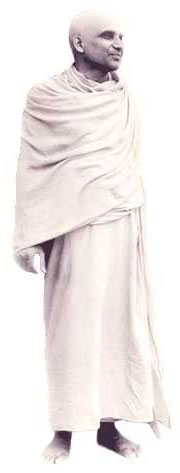
strength by way of indulgence in multitudinous activities of life. Swami Sivanandaji
Maharaj used to say: "Tapas is nothing but burning like fire with the heat of
energy by the control of the senses". One who performs Tapas has a glow in his
face, a lustre in his eyes, an aura around his personality, a strength in his
speech, and a capacity in his body on account of the austerity that he
performs. Every word that he speaks will have a tremendous force and will carry
conviction. But for his Tapas, the same word will be a cold word which may not
fall into the ears of any person. Tapas is austerity of the whole
personality - body, speech, senses and the mind. Tapas is one of the observances
or Niyamas.
Svadhyaya
or Sacred Study
Now, these three principles of Niyama
mentioned already, namely, Saucha, Santosha, and Tapas - purity, contentment and
austerity - are difficult of practice unless they are accompanied by certain
easier practices. The principal items of Niyama that we have already mentioned
are difficult things. And as they are difficult, they have to be accompanied by
certain other contributory practices, such as the study of sacred scriptures.
When everything is impossible of practice, we can at least study a scripture.
We can go on reciting loudly certain chapters of the Bhagavad Gita, we will
feel inspired. We can read loudly certain chapters of the Dhammapada or the
Sermon on the Mount or "The Imitation of Christ". We can recite aloud the great
songs of the Alvars and the Nayanars, the saints and the sages, the Bhaktas and
the devotees. There are the writings of the Masters, the Yogis, and the adepts.
We can study their inspired expositions and ourselves feel inspired. We can do
Parayana of the Srimad Bhagavata, the Vishnu Purana, the Mahabharata. We will
be stimulated from within in a superior way. That itself will be Tapas.
Svadhyaya itself is a great austerity, a great devotion, a worship, a
meditation.
Svadhyaya is a religion by itself. There are some people
who spend their whole life in Parayana only. They neither know nor do any Yoga
practice other than Parayana. The spiritual seeker should go on reciting a
sacred scripture everyday, concentrating his mind on its meaning, absorbing his
mind in it and becoming that almost. Because, when he cannot summon sublime
thoughts to his mind independently by himself, he has to take the aid of the
thoughts of the great people which are recorded in the scriptures. When he
cannot think for himself, he can at least acquiesce in the nature of the
thinking of other persons who are superior to him, thinking which can be
communicated to him by their words, discourses and writings. Svadhyaya is not
going to a library and reading anything that is there. That is a different
thing altogether. Svadhyaya is sacred study, a study of one's own self, 'Sva-adhyaya',
or rather, a study of anything that is connected with the nature of one's own
self, that is connected with the practice of austerity, connected with the goal
of life, the aim of Yoga or God-realisation. It is sacred study that we call
Svadhyaya and not the reading of any book for the purpose of information
merely. If one reads the Encyclopedia Britannica, it is not Svadhyaya, though
one may gather a lot of information from it. Svadhyaya is sacred study of a
holy scripture imbued with and charged with divinity, because such a scripture
is a record of the words of great incarnations, mighty sages. The chanting of
Mantras is also regarded as a part of Svadhyaya. Japa of Om, or of one's own
Ishta Mantra into which one has been initiated by his Guru, is also regarded as
a part of Svadhyaya, in addition to the study of a scripture or a holy text.
So, Japa of a Mantra or study of a holy scripture is Svadhyaya, which one can
resort to with benefit.
Isvara
Pranidhana or Self-surrender to God
Isvara Pranidhana is the fifth item
mentioned under the Niyamas. A daily prayer to God is a great Tapas by itself.
When we get up in the morning, we must offer a prayer from the bottom of our
heart, from the depth of our soul, weeping and crying for God. It is a great
meditation; it is a complete Yoga by itself. More things are wrought by prayer
than this world dreams of. Prayer is a tremendous power. It is an independent
Yoga by itself and it does not require any other accessory to it. By mere
prayer we can reach God, we can attain the great goal of Yoga, provided the
heart prays and not merely the lips. Our prayers do not always come from the
heart. The mass that is performed in the church, or the Puja that is performed
in the temple, is but a mere mechanical routine. People have to complete a
routine, and they have to go to temple and church, but their mind is not there.
Their heart does not melt, and when they pray, they neither cry nor weep.
Therefore, their prayer cannot be called prayer. God listens to the prayer that
comes from the soul of man and not to the prayer that emanates merely from his
lips in so many words. So, Isvara Pranidhana or self-surrender to God, implying
prayer, worship, dedication, and various other forms of worship, is regarded as
one of the Niyamas.
The observances - Saucha, Santosha, Tapas,
Svadhyaya and Isvara Pranidhana - are personal practices of a religious nature,
in the true, sense of the term, and they have to go hand in hand with the
Niyamas - Ahimsa, Satya, Asteya, Brahmacharya and Aparigraha - already mentioned.
Thus, Yama and Niyama form the rock-bottom of the other stages of Yoga, and in
this way, are the central forte, as it were, of Yoga practice. These Yamas and
Niyamas are not moral or ethical sermons that are given by the Yoga teachers.
They are scientific disciplines, unavoidable and inviolable under all
circumstances. The stages of our attunement to the various evolutionary stages
of Prakriti are the stages of the practice of Yoga. Patanjali's system of
Samyama - concentration, meditation and Samadhi - is nothing but the systematised
technique of setting the various levels of individuality in tune with the
various levels of the cosmos. That is why we say that Samkhya is the base of
Yoga, and that a knowledge of the nature of Purusha and Prakriti is necessary
for an understanding of the nature of the various stages of discipline in the
system of Patanjali known as Yama, Niyama, Asana, Pranayama, Pratyahara,
Dharana, Dhyana and Samadhi.
|